Key Watchtower Publications — Historical Overview
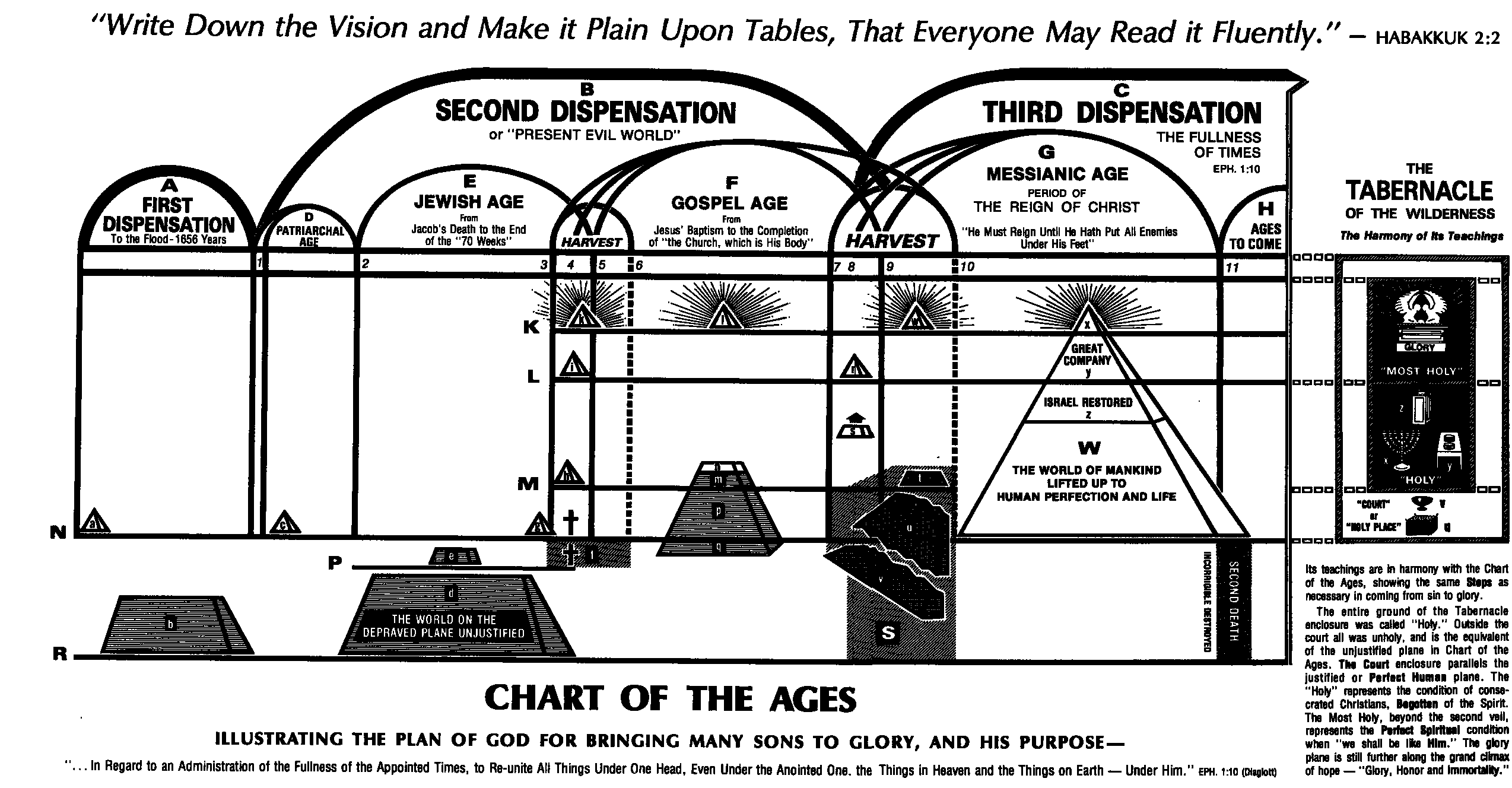 Studies in the Scriptures series by C.T. Russell.
The Watchtower organization has, from its founding, functioned in significant part as a publishing enterprise. From its founding in 1879, the movement has been defined by its printed materials — and the authority those materials claim. Charles Taze Russell declared that his writings were so essential to understanding the Bible that abandoning them would lead a reader "into darkness" within two years. Rutherford's Golden Age magazine promoted anti-vaccination conspiracies and declared aluminum cookware satanic. The organization's own Bible translation has been criticized by scholars for inserting the name "Jehovah" where the original manuscripts do not support it and for tailoring key passages to match denominational theology. A secret elders' manual — leaked repeatedly — reveals policies never disclosed to the rank and file. And in the digital age, the shift to JW.org and JW Broadcasting has enabled the quiet scrubbing of decades of embarrassing content from the historical record. Publications are not merely how the organization communicates — they shape what members believe, how they behave, and what information they access.
The Watchtower Magazine (1879–Present)
Zion's Watch Tower and Herald of Christ's Presence was first published in July 1879 by Charles Taze Russell in Pittsburgh, Pennsylvania. The initial print run was 6,000 copies. Russell funded the publication personally and declared that if Jehovah failed to provide funds, "we will understand it to be time to suspend the publication." The magazine has never missed an issue in over 145 years.[1]
The magazine's name has evolved over time:
| Period | Title | Notes |
|---|---|---|
| 1879–1909 | Zion's Watch Tower and Herald of Christ's Presence | Russell as editor and publisher |
| 1909–1931 | The Watch Tower and Herald of Christ's Presence | "Zion's" dropped |
| 1931–1939 | The Watchtower and Herald of Christ's Presence | Spelling consolidated |
| 1939–present | The Watchtower Announcing Jehovah's Kingdom | Currently published in 413 languages annually; separate study and public editions since 2008 |
The Watchtower is not presented as a magazine of opinion. It is presented as God's channel of communication to humanity, mediated through the Faithful and Discreet Slave. Members are expected to study each issue weekly and to accept its contents as authoritative spiritual direction. Disagreement with Watchtower teachings is grounds for disfellowshipping as apostasy.
Studies in the Scriptures (1886–1917)
Russell authored six volumes of a series originally titled Millennial Dawn, later renamed Studies in the Scriptures:
| Vol. | Year | Title |
|---|---|---|
| I | 1886 | The Divine Plan of the Ages |
| II | 1889 | The Time Is at Hand |
| III | 1891 | Thy Kingdom Come |
| IV | 1897 | The Day of Vengeance |
| V | 1899 | The At-One-Ment Between God and Man |
| VI | 1904 | The New Creation |
| VII | 1917 | The Finished Mystery (posthumous; authors Clayton Woodworth and George Fisher, edited by Rutherford) |
Russell made an extraordinary claim about these volumes: "if he then lays [the Studies in the Scriptures] aside and ignores them and goes to the Bible alone, though he has understood his Bible for ten years, our experience shows that within two years he goes into darkness."[4]
The Finished Mystery (Volume VII, 1917) was particularly controversial. Published seven months after Russell's death and presented as his "posthumous work," it was actually written by Woodworth and Fisher under Rutherford's direction. Its release at the Bethel headquarters on July 17, 1917 triggered an immediate power struggle: four members of the Society's Board of Directors opposed it, and many congregations split. The book's content — including anti-Catholic and anti-war statements — contributed to the arrest of Rutherford and seven associates under the Espionage Act in 1918. Rutherford's remaining Studies volumes were eventually phased out; by 1927, he ordered remaining stocks disposed of, though they continued to be sold for decades afterward.[5]

Coping with toxic family dynamics, estrangement, and rebuilding your life. For anyone dealing with the fallout of leaving a high-control group.
View on Amazon →The Golden Age / Consolation / Awake! (1919–Present)
The Golden Age magazine debuted on October 1, 1919, as a companion publication to the Watchtower. Edited by Clayton J. Woodworth (co-author of The Finished Mystery), it was intended as a general-interest magazine for the public rather than a theological journal. It was renamed Consolation in 1937 and Awake! in 1946.[6]
Under Woodworth's editorship, the Golden Age promoted an extraordinary range of pseudoscientific and conspiratorial content:
- Anti-vaccination: "Vaccination has never saved a human life. It does not prevent smallpox" (Golden Age, February 4, 1931). Vaccination was described as "a direct violation of the everlasting covenant" with God.
- Aluminum cookware conspiracy: Aluminum was presented as a satanic substance responsible for ailments ranging from athlete's foot to cancer. The campaign continued for years after mainstream science had established aluminum cookware's safety.
- Anti-germ theory: Multiple articles rejected the germ theory of disease, arguing that germs associated with diseases followed rather than caused them.
- Quack medical devices: The magazine endorsed the "Radio-Solar Pad" (a device containing radium worn on the body — Rutherford himself used one), the "Electronic Radio Biola" (invented by a Witness), "Zone Therapy," "Iridiagnosis," and numerous other discredited treatments.
- Anti-medicine: The publication was consistently hostile to orthodox medicine, rarely publishing anything favorable until decades later.[7]
Millions Now Living Will Never Die (1920)
Rutherford's 1920 booklet — based on a public lecture series — predicted that 1925 would mark the return of the Hebrew patriarchs Abraham, Isaac, and Jacob to earth, and that millions of people then alive would survive into an earthly paradise. The campaign included massive billboard and newspaper advertisements. When the prediction failed, membership plummeted and Rutherford later recast the failed prediction as an honest mistake, saying "the Lord did not so arrange." See The 1925 Prophecy Failure for the full account.[8]
Aid to Bible Understanding (1971) and Insight on the Scriptures (1988)
Aid to Bible Understanding (1971) was the first Bible encyclopedia produced by the organization — a 1,696-page reference work. Raymond Franz, who would later become a Governing Body member and then the organization's most famous dissident, was one of the primary researchers and writers. His research for the "Chronology" entry led him to discover that the organization's 607 BCE date for Jerusalem's destruction — the linchpin of the 1914 chronology — could not be supported by any archaeological or historical evidence. This discovery contributed to his eventual crisis of conscience.[9]
In 1988, Aid was replaced by Insight on the Scriptures, a two-volume set that retained much of the original content but revised entries to align with doctrinal changes that had occurred in the intervening years. According to reader reports, the online entries have reportedly been edited to reflect further doctrinal shifts — including the 2013 redefinition of the "Faithful and Discreet Slave" — without notification that changes have been made.[10]
The New World Translation (1950–2013)
The New World Translation of the Holy Scriptures (NWT) is the organization's own Bible translation, produced anonymously by the "New World Bible Translation Committee." The identity of the translators has never been officially disclosed, though former Governing Body member Raymond Franz and others have identified the committee members as Nathan Knorr, Frederick Franz, Albert Schroeder, George Gangas, and Milton Henschel. Of these, only Frederick Franz had any formal training in biblical languages, having studied Greek at the University of Cincinnati (he did not graduate). None held advanced degrees in biblical scholarship.[11]
The New Testament (titled New World Translation of the Christian Greek Scriptures) was released in 1950; the complete Bible was published in 1961. A major revision was released in 2013, simplifying the language and incorporating the organization's most recent doctrinal positions. As of 2025, it has been published in whole or part in over 130 languages.
The translation has been criticized by mainstream biblical scholars on several grounds. The most controversial feature is the systematic insertion of the name "Jehovah" (a hybrid English rendering of the Tetragrammaton) 237 times in the New Testament — despite the fact that no existing Greek manuscript of the New Testament contains the Tetragrammaton. The NWT committee justified this practice by arguing that the original New Testament writers must have used God's name and that later copyists removed it — a hypothesis not supported by textual evidence. Additionally, scholars have criticized the rendering of John 1:1 as "the Word was a god" (rather than "the Word was God"), a translation choice that supports the organization's rejection of the Trinity but is considered grammatically unjustified by the majority of Greek scholars. The NWT is the only Bible translation used in Watchtower publications, meetings, and personal study, creating a closed hermeneutical loop in which the organization's theology is confirmed by its own translation.[12]
Jehovah's Witnesses — Proclaimers of God's Kingdom (1993)
The Proclaimers book is the organization's official history, published in 1993. At 750 pages, it represents the most comprehensive account the organization has produced of its own development. It acknowledges some embarrassing episodes — the failed 1925 prophecy, early pyramidology, Beth-Sarim — but consistently frames them in the most favorable possible light, omitting critical details and minimizing leadership responsibility.
Notable omissions and distortions include: the Malawi-Mexico double standard receives no mention; the blood doctrine's evolution is presented without acknowledging the deaths it caused; Russell's pyramidology is dismissed as a minor curiosity rather than a central element of his chronological system; the 1980 headquarters purge that resulted in Raymond Franz's departure is not discussed; and the organization's early anti-Semitic statements and the 1933 Declaration of Facts (which sought accommodation with the Nazi regime) are either omitted or treated superficially. Members are directed to rely on what the Proclaimers book tells them about their history and are warned against consulting "apostate" sources — which, in practice, includes any source that provides details the Proclaimers book omits.[13]
Shepherd the Flock of God — The Secret Elders' Manual
Shepherd the Flock of God (ks in internal abbreviation) is the confidential handbook provided exclusively to appointed elders. It contains detailed instructions for handling judicial committees, disfellowshipping procedures, child abuse reporting protocols, and numerous other policies that directly affect members' lives but are never disclosed to the congregation. Female members — who cannot serve as elders — are structurally excluded from ever seeing the rules that govern their own discipline.[14]
The manual has been leaked multiple times — most notably in 2010 when a complete digital copy became widely available online. Each leak has been treated by the organization as a serious breach. The manual's contents have been cited extensively in court cases, including the Australian Royal Commission, where its instructions regarding child abuse handling were examined in detail. Among its most controversial directives: the instruction to contact the Watchtower Legal Department before contacting police when allegations of child abuse are received, and the application of the two-witness rule to abuse cases.
The Digital Transition: JW.org and JW Broadcasting
The organization launched JW.org as its primary public-facing website in 2012, rapidly making it one of the most visited religious websites in the world. JW Broadcasting (tv.jw.org) launched in 2014, providing monthly video broadcasts featuring Governing Body members — the first time these leaders appeared regularly before the general membership on camera.[15]
The digital shift has had several significant consequences:
Reduced print output. The Watchtower public edition and Awake! have been reduced from monthly to annual publication. Books, brochures, and tracts have been cut dramatically. Kingdom Halls have reduced or eliminated physical literature supplies.
Content scrubbing. The Watchtower Online Library (wol.jw.org) contains digital versions of many older publications — but not all of them, and not always in their original form. Content from older issues that contradicts current teachings or that the organization may find unfavorable has been omitted or quietly revised. The Golden Age issues with anti-vaccination and aluminum conspiracy content are not available on the official site. Older Watchtower articles containing failed prophecy dates, discarded doctrines, or statements that contradict current teaching are absent from the digital library or, according to JWfacts and side-by-side comparisons, appear to have been revised without notice.
Centralized message control. JW Broadcasting allows the Governing Body to deliver a uniform, carefully produced message to every congregation worldwide simultaneously. This eliminates the variability that once existed when local elders interpreted written instructions differently. Governing Body members now function as recognizable media figures.
Surveillance of access. The JW.org and JW Library app ecosystem can technically log which content is accessed and how. Members are encouraged to use official digital tools exclusively and are warned against "independent research" using unauthorized sources.[16]
Publications as Control
The publishing enterprise functions as the organization's primary mechanism of doctrinal control, as documented by Raymond Franz in Crisis of Conscience and analyzed on JWfacts.com. The system works through several interlocking features:
Volume and repetition. Members are expected to study the weekly Watchtower lesson, prepare for midweek meetings, read the daily text, conduct personal Bible study using official publications, and use only the NWT. Virtually all input comes from a single source.
Proprietary vocabulary. The publications create and enforce a specialized vocabulary — "the truth," "the world," "worldly," "the faithful and discreet slave," "new light," "spiritual food," "apostate" — that frames reality in organizational terms.
Obsolescence by design. Old publications are replaced by new ones that revise or contradict their predecessors. Members are discouraged from studying older publications and are taught to value "current truth" over past statements. This allows the organization to change positions without formally admitting error, since the old position simply ceases to exist in the current literature.
Authority without authorship. Almost all Watchtower publications are published anonymously or under the collective name of the organization. This prevents individual accountability for specific claims and allows the institution to distance itself from statements when they become unfavorable — attributing them to unnamed "imperfect men" who were doing their best at the time.[17]
See Also
- The New World Translation — Detailed analysis of the organization's Bible translation
- Shepherd the Flock of God — The Secret Elders' Manual — The confidential handbook
- Charles Taze Russell (1852–1916) — Founder of the publishing enterprise
- Information Control & Thought Reform — How publications function as control mechanisms
- The 'Faithful and Discreet Slave' — Shifting Identity — The theological basis for publication authority
References
1. ↩ "Zion's Watch Tower," July 1879: initial print run 6,000 copies; Russell's pledge regarding funding. Also "Noteworthy Events in the Modern-day History of Jehovah's Witnesses," JW.org; EBSCO Research Starters: Russell split from Barbour, founded magazine 1879. [jw.org]
2. ↩ "Jehovah's Witnesses publications," Wikipedia: magazine name evolution; currently published in 413 languages annually. Also Watchman Fellowship history timeline. [en.wikipedia.org]
3. ↩ "Studies in the Scriptures," Wikipedia: six volumes by Russell 1886–1904; Volume VII (1917) by Woodworth and Fisher. Also Goodreads entry for The Finished Mystery: "true authors were Clayton J. Woodworth and George Fisher." [en.wikipedia.org]
4. ↩ Studies in the Scriptures, Wikipedia: Russell's statement that abandoning his writings leads to "darkness" within two years. [en.wikipedia.org]
5. ↩ "Noteworthy Events," JW.org: Finished Mystery released July 17, 1917; four Board members opposed; congregations split; Rutherford arrested under Espionage Act 1918. Also Watchman Fellowship: stocks disposed of 1927 but continued to be sold. [watchman.org]
6. ↩ "Noteworthy Events," JW.org: Golden Age first published October 1, 1919; renamed Consolation 1937; renamed Awake! 1946. [wol.jw.org]
7. ↩ "The Watchtower Society and Medical Quackery," JW Research: anti-vaccination quotes; aluminum cookware conspiracy; anti-germ theory; Radio-Solar Pad; Electronic Radio Biola; "bizarre material on health." Also Watchman Fellowship: "Vaccination has never saved a human life" (Golden Age, February 4, 1931). [kenraines.com]
8. ↩ Millions Now Living Will Never Die (1920): 1925 prophecy; billboard campaign. See also The 1925 Prophecy Failure. [watchman.org]
9. ↩ "Raymond Franz," Wikipedia: assigned to write Aid to Bible Understanding; appointed Governing Body member October 20, 1971. Also "Raymond Franz — The Jerusalem Book": research on Chronology entry; failed to find evidence for 607 BCE. [en.wikipedia.org]
10. ↩ "Jehovah's Witnesses publications," Wikipedia: Aid replaced by Insight on the Scriptures (1988); contains much of original content. Forum reports of online Insight entries being quietly modified. [en.wikipedia.org]
11. ↩ "Jehovah's Witnesses publications," Wikipedia: NWT committee members never officially disclosed; Raymond Franz identified them as Knorr, Franz, Schroeder, Gangas, Henschel. NWT Christian Greek Scriptures 1950; complete Bible 1961; revised 2013; published in 130+ languages. [en.wikipedia.org]
12. ↩ "New World Translation of the Holy Scriptures," Wikipedia: "Jehovah" inserted 237 times in NT without manuscript support; John 1:1 rendered "a god"; scholarly criticism of translation choices. See The New World Translation for full analysis. [en.wikipedia.org]
13. ↩ Jehovah's Witnesses — Proclaimers of God's Kingdom (1993): 750-page official history; acknowledges some embarrassments but omits Malawi-Mexico double standard, 1980 headquarters purge, blood doctrine deaths, and 1933 Declaration of Facts. [jw.org]
14. ↩ Shepherd the Flock of God: confidential elders' manual; leaked 2010; cited in Australian Royal Commission Case Study 29. See Shepherd the Flock of God — The Secret Elders' Manual. [childabuseroyalcommission.gov.au]
15. ↩ JW.org launched 2012; JW Broadcasting launched 2014; "Jehovah's Witnesses publications," Wikipedia. [en.wikipedia.org]
16. ↩ Digital transition analysis compiled from JWfacts.com, AvoidJW.org, and observable changes in publication frequency and availability on wol.jw.org. [jwfacts.com]
17. ↩ Publications-as-control analysis drawn from JWfacts.com ("Information Control") and Raymond Franz, Crisis of Conscience. [jwfacts.com]