The 1980 Bethel Purge
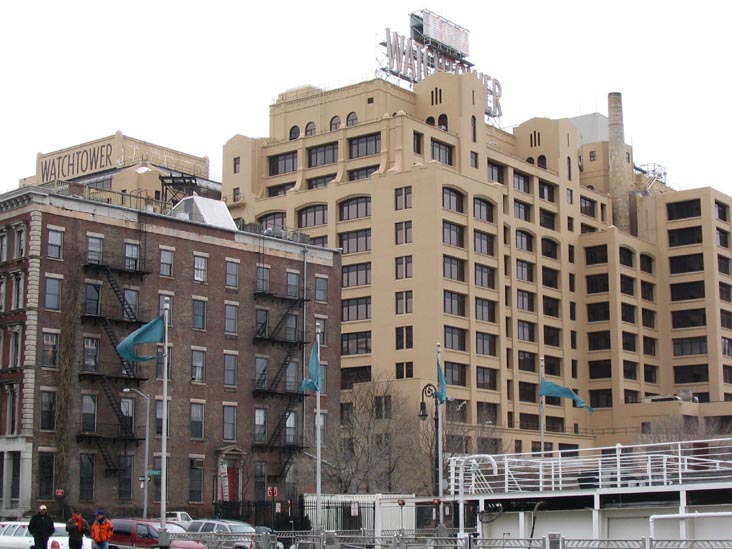 Watchtower sign and building, Brooklyn. Via Wikimedia Commons.
In the spring of 1980, the Watchtower organization conducted a secret internal investigation at its Brooklyn headquarters that would become the most significant purge of dissent in the group's modern history. In the aftermath of the 1975 prophecy failure — which had cost the organization hundreds of thousands of members — a growing number of headquarters staff had begun quietly questioning core Watchtower doctrines, particularly the significance of 1914, the two-class system of Christians, and the organization's claim to exclusive divine authority. The Governing Body responded with an internal investigation. Staff members were interrogated about their private beliefs. According to accounts from those involved, private conversations were reported, investigated, and used as the basis for judicial action. Those who could not affirm complete loyalty to every current Watchtower teaching — regardless of how scripturally grounded their concerns — were expelled. The most prominent casualty was Raymond Franz, a Governing Body member whose Crisis of Conscience would become the most important book ever written about the organization. The purge's significance extends beyond who it expelled — it accomplished the suppression of internal dissent and established a culture in which questioning organizational teachings was treated as apostasy.
Context: The Post-1975 Crisis
The purge cannot be understood apart from the 1975 prophecy catastrophe. Throughout the late 1960s and early 1970s, Watchtower publications had strongly implied — and in some cases explicitly stated — that Armageddon would arrive in or around 1975, based on a calculation that 6,000 years of human history would end that year. Hundreds of thousands of Witnesses sold homes, abandoned careers, deferred medical treatment, and postponed education in anticipation of the end.
When 1975 passed without incident, the fallout was devastating. Worldwide publisher growth, which had been running at 5–13% annually through the early 1970s, collapsed. Between 1976 and 1979, the organization lost an estimated 750,000 members. The Governing Body's credibility was severely damaged — and some members of the headquarters staff began, for the first time, to privately question whether the organization's prophetic framework was fundamentally flawed.
The March 15, 1980 Watchtower issued a partial acknowledgment of the 1975 debacle, admitting that the organization's publications had "apparently overshadowed the cautionary ones and contributed to a buildup of expectation already initiated." It told disappointed Witnesses — pointedly including "persons having to do with the publication of the information that contributed to the buildup of hopes centred on that date" — to "concentrate on adjusting [their] viewpoint." This statement was widely understood as a reference to Raymond Franz, who had served as chairman of the Writing Committee, and it effectively blamed him for expectations that the entire Governing Body had promoted.[1]
The Investigation Begins
April 1980: The "Judicial Machinery" Starts Moving
In March 1980, Raymond Franz and his wife Cynthia took a leave of absence from Brooklyn headquarters for health reasons, staying at the Alabama property of fellow Witness Peter Gregerson. While they were away, the storm broke.
In April 1980, the Governing Body's Chairman's Committee — then headed by Albert Schroeder — launched a secret investigation into "wrong teachings" being spread by headquarters staff. The investigation was triggered by reports of private conversations in which Bethel staff members had discussed doubts about Watchtower doctrines. The doctrines in question included: the significance of 1914, the two-class system (144,000 "anointed" vs. the "great crowd"), the exclusive authority of the "faithful and discreet slave," and the scriptural basis for various organizational teachings.
On April 22, 1980, Schroeder phoned Franz in Alabama to inform him that "the judicial machinery of the organization was in operation and moving rapidly against these ones." Franz later described the language as reducing people with honest questions to targets of a bureaucratic process.[2]
The First Casualties
On April 25, 1980, the first disfellowshippings occurred. Cris Sanchez and his wife Nestor Kuilan, long-time members of the headquarters staff, were disfellowshipped. René Vázquez, who had worked for many years in the Service Department, and his wife were also disfellowshipped. All were accused of "apostasy" — defined, in practice, as having expressed doubts about Watchtower doctrines in private conversations.
The method of investigation was deeply troubling even to those who witnessed it from within the organization. Staff members were summoned individually and questioned about their beliefs — not about their conduct, not about any harmful action, but about what they thought. They were asked whether they agreed with specific Watchtower doctrines. According to Franz's account, some were threatened with disfellowshipping to compel them to provide testimony about the private doctrinal discussions of others. TIME magazine later described these as "star-chamber tactics."[3]
Coping with toxic family dynamics, estrangement, and rebuilding your life. For anyone dealing with the fallout of leaving a high-control group.
View on Amazon →Raymond Franz: The Interrogation
May 19–21, 1980
On May 19, Franz returned to Brooklyn headquarters and found a packet of documents on his desk containing legalistic questions about Watchtower beliefs — effectively a loyalty test.
On May 20, he met with the Chairman's Committee. During this session, he was played a tape-recorded interview of a married Witness couple who had spoken about rumors of private meetings where Watchtower teachings were being discussed. Franz later described the tape as filled with leading questions and pressure tactics designed to extract information that could be used as grounds for apostasy charges. The couple had been interrogated, not counseled.
On May 21, Franz was called before the full Governing Body for a session that was tape-recorded. For three hours, his former colleagues questioned him about his biblical viewpoints and his commitment to Watch Tower doctrines. The questions went to the heart of his personal beliefs:
- Did he believe that the Governing Body was the "faithful and discreet slave"?
- Did he accept that 1914 marked Christ's invisible enthronement?
- Did he agree with the two-class distinction between the 144,000 and the "great crowd"?
- Did he accept that Jehovah's Witnesses were the sole channel of divine communication?
Following the interrogation, Franz agreed to resign from the Governing Body and headquarters staff. The August 1980 Our Kingdom Ministry (p. 2) carried the announcement: "Raymond Victor Franz is no longer a member of the Governing Body and of the Brooklyn Bethel family as of May 22, 1980." The Watch Tower Society offered him a monthly stipend as a member of the "Infirm Special Pioneers" — which he refused.[4]
Edward Dunlap: The Scholar Expelled
Edward Dunlap (1908–1999) was perhaps the most intellectually respected person at Brooklyn headquarters. He had served as registrar and instructor at the Watchtower Gilead Bible School (the organization's missionary training school), was a primary contributor to the Aid to Bible Understanding encyclopedia, and had authored the Commentary on the Letter of James — the organization's only verse-by-verse biblical commentary. His full-time service record matched Franz's in length: over 40 years.
Dunlap's concerns had developed independently but along similar lines. He had begun to question the two-class system, the organization's claim to exclusive authority, and the scriptural basis for various doctrines. He had shared these concerns in private conversations with friends — conversations that were reported to the investigating committee.
In the spring of 1980, two Governing Body members — Lloyd Barry and Jack Barr — came to Dunlap's office and questioned him for three hours about his personal beliefs. When Dunlap asked, "What is the purpose of this judicial interrogation?" they assured him it was merely informational. It was not.
Subsequently, a committee of five Bethel elders — none of them Governing Body members — met with Dunlap in a secret session lasting several hours. They questioned him about his views on the organization, on 1914, on the two classes of Christians, and on the heavenly hope. According to Franz, the committee "recognized that Edward Dunlap had a deep love for God, for Christ and for the Bible — and yet they felt they had to take action against this man" because "loyalty to the organization required such action."
Dunlap was disfellowshipped and expelled from Bethel. At 72 years of age, after four decades of service, he and his wife Betty left Brooklyn headquarters with little more than the clothes on their backs. They returned to Oklahoma City, where, according to former associates, Ed supported himself and Betty by hanging wallpaper. By one account, he died of a heart attack several years later. According to former associates, Betty spent her final years in a nursing home. Neither of the Dunlaps ever attempted to "start their own religion" or cause a schism — by all accounts, they had simply expressed their honest views about the Bible.[5]
The Scope of the Purge
The purge extended well beyond Franz and Dunlap. Contemporary accounts estimate that 30 to 40 staff members were expelled from Brooklyn headquarters in late 1980 and early 1981. The targets were concentrated in the Writing Department, the Translation Department, and other research-oriented roles — precisely the departments where staff were most likely to have encountered the kinds of textual and historical problems that generated doubt.
The atmosphere at Bethel during this period was one of fear and suspicion. Staff members became afraid to discuss the Bible with each other. Private study of scripture — without the mediating lens of Watchtower publications — was treated as inherently suspicious. One former Bethelite recalled the dining hall announcement of Dunlap's disfellowshipping as a scene where "people were weeping" and the room felt "surreal." The message was unmistakable: if someone with forty years of service and the deepest biblical knowledge at headquarters could be expelled for his private beliefs, no one was safe.[6]
The September 1 Letter: Criminalizing Thought
The Governing Body's most consequential response to the crisis was not the individual disfellowshippings but a policy change that redefined apostasy itself. On September 1, 1980, the Governing Body distributed a letter to all Circuit and District Overseers under the heading "Protecting the Flock." The letter stated that individuals who persisted in "believing other doctrine despite scriptural reproof" were committing apostasy and warranted "appropriate judicial action."
This was a watershed moment. Previously, apostasy required promoting false doctrines — actively teaching or spreading ideas contrary to Watchtower teaching. The September 1980 letter eliminated that requirement. Under the new standard, a person could be disfellowshipped for merely believing something different — even if they never told another soul. The crime was not the act of teaching but the act of thinking. If elders became aware, through whatever means, that a member held a belief at variance with Watchtower doctrine — and the member refused to abandon that belief when confronted — disfellowshipping was warranted.
This policy remains in effect. It is the doctrinal foundation upon which all subsequent treatment of "apostates" rests: the claim that the Governing Body has the right not merely to control what members say and do, but what they believe.[7]
Raymond Franz's Disfellowshipping
Franz's story did not end with his resignation. After leaving headquarters, he continued to live in Alabama, working on Peter Gregerson's property. On March 18, 1981, Gregerson submitted a letter of disassociation from Jehovah's Witnesses. The September 15, 1981 Watchtower then announced a change of policy: those who formally disassociated were henceforth to be shunned in the same manner as those disfellowshipped. This meant that Franz, who continued to socialize with his employer Gregerson, was now associating with a disassociated person.
On November 25, 1981, Franz was summoned to a judicial hearing and disfellowshipped — not for apostasy, not for teaching false doctrines, but for sharing a meal with a disassociated person. The charge was technically a violation of the new shunning policy. The effect was the severing of nearly every relationship Franz had built over a lifetime of service.
Franz responded by writing Crisis of Conscience (1983) and In Search of Christian Freedom (1991) — books that remain the most detailed insider accounts of the Governing Body's operations ever published and that have helped thousands of people leave the organization.[8]
The Lasting Impact
The 1980 purge did not merely remove a handful of dissenters. It fundamentally reshaped the organizational culture of Jehovah's Witnesses in ways that persist to this day:
Independent Bible study became suspect. TIME magazine reported that at Bethel, "reading or studying of the Bible is considered 'evil' unless conducted in authorized discussions following Watch Tower doctrinal guides, lest staffers veer into error." This attitude — that private Bible study outside the framework of Watchtower publications is dangerous — was institutionalized after 1980 and remains embedded in the organization's information control practices.
The Governing Body became more authoritarian. M. James Penton concluded in his study Apocalypse Delayed that since Franz's expulsion, the Governing Body displayed "an increased level of conservatism, sturdy resistance to changes of policy and doctrines, and an increased tendency to isolate dissidents within the organization by means of disfellowshipping." Penton argued the purge removed the voices most likely to challenge groupthink and replaced them with silence.
Doubt became equated with betrayal. Before 1980, it was at least theoretically possible for a Witness to express a private doubt without being accused of apostasy. After the September 1980 letter, the mere act of holding a different belief — even silently — constituted a disfellowshipping offense. This created the PIMO phenomenon: thousands of members who no longer believe but dare not say so.
Parallels with historical inquisitions. Franz himself drew an explicit parallel to inquisitorial methods, describing the investigation as an "inquisition." The 1980 investigation featured secret proceedings, interrogation of private beliefs, testimony from associates, consequences for belief rather than action, and no independent avenue of appeal.[9]
See Also
- Raymond Franz & Crisis of Conscience — The full story of the purge's most prominent target
- The 1975 Prophecy Catastrophe — The failed prediction that created the conditions for the purge
- The Governing Body — Structure, History & Power — The body that authorized the investigation
- Disfellowshipping & Shunning — Complete History — The weapon used against the dissenters
- Information Control & Thought Reform — The regime that the purge established
- The 'Faithful and Discreet Slave' — Shifting Identity — The doctrine the dissenters questioned
- Governing Body Authority — The Scriptural Case Against It — Scriptures that support the questions Dunlap and Franz raised
References
1. ↩ Post-1975 context: Watchtower, Mar 15, 1980: partial acknowledgment — "apparently overshadowed the cautionary ones." Membership losses: see The 1975 Prophecy Catastrophe. Wikipedia, "Raymond Franz." [en.wikipedia.org]
2. ↩ Investigation launch: Albert Schroeder phone call to Franz, Apr 22, 1980 — "judicial machinery of the organization was in operation." Raymond Franz, Crisis of Conscience (Commentary Press, 1983). ExJW.org.uk, "Raymond Franz: former Jehovah's Witness." [exjw.org.uk]
3. ↩ First disfellowshippings: Cris Sanchez, Nestor Kuilan, René Vázquez and wife — Apr 25, 1980. "Star-chamber tactics": "Religion: Witness Under Prosecution," TIME, Feb 22, 1982. Wikipedia, "Raymond Franz." [time.com]
4. ↩ Franz interrogation: May 19–21, 1980; three-hour Governing Body session; tape-recorded; resignation May 22, 1980. Our Kingdom Ministry, Aug 1980, p. 2. Crisis of Conscience; Wikipedia, "Raymond Franz"; Find a Grave memorial. [en.wikipedia.org]
5. ↩ Edward Dunlap: Gilead registrar/instructor; Aid to Bible Understanding contributor; Commentary on James author; interrogated by Lloyd Barry and Jack Barr; committee of five Bethel elders; disfellowshipped; returned to Oklahoma City; hung wallpaper. Crisis of Conscience, pp. 236–237. ChannelC² Experiences, "Betty & Ed Dunlap." WatchtowerLies.com, "Who was Edward Dunlap?" [channelc2-experiences]
6. ↩ Scope of purge: 30–40 staff expelled, primarily from Writing and Translation departments. Grokipedia, "Governing Body of Jehovah's Witnesses." Bethel dining hall testimony: jehovahs-witness.com forum, "Ed Dunlap Describes His Experience." [jehovahs-witness.com]
7. ↩ September 1, 1980 letter: "believing other doctrine despite scriptural reproof" = apostasy warranting judicial action. Wikipedia, "Raymond Franz"; ExJW.org.uk. [en.wikipedia.org]
8. ↩ Franz disfellowshipping: Gregerson disassociation Mar 18, 1981; Watchtower Sep 15, 1981 policy change on disassociated persons; Franz disfellowshipped Nov 25, 1981 for sharing a meal. Crisis of Conscience (1983); In Search of Christian Freedom (1991). Wikipedia. [en.wikipedia.org]
9. ↩ Lasting impact: TIME, Feb 22, 1982 — Bible study "considered evil" at Bethel without Watchtower guides. M. James Penton, Apocalypse Delayed (University of Toronto Press, 1997), p. 214 — "increased level of conservatism." Wikipedia, "Governing Body of Jehovah's Witnesses." [en.wikipedia.org]