Watchtower Pyramidology
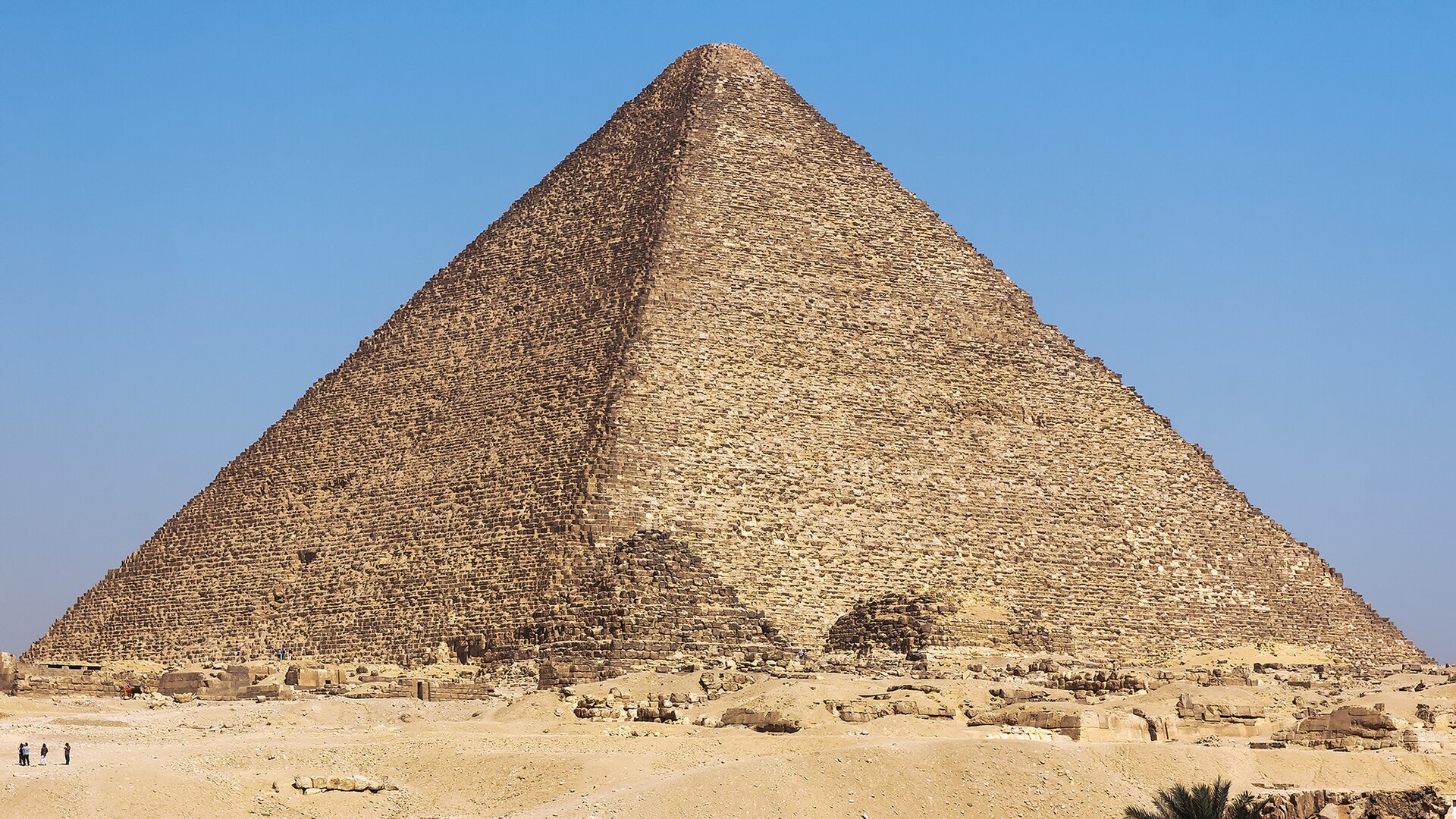 Great Pyramid of Giza. Photo by Nina Aldin Thune, Wikimedia Commons. CC-BY-SA 2.0.
Most Jehovah's Witnesses today have no idea that the foundational prophetic date of their religion — 1914, the year they believe Christ began ruling invisibly from heaven — was partly derived from measurements of the interior passages of the Great Pyramid of Giza. Charles Taze Russell, the founder of the Bible Student movement, was convinced that the Great Pyramid was "God's Stone Witness" — a divinely designed structure whose corridors and chambers, when measured in "pyramid inches," confirmed his biblical chronology. He devoted an entire volume of his magnum opus, Studies in the Scriptures, to this subject, complete with detailed diagrams and calculations. When his initial measurements pointed to 1874 as the year of prophetic significance and that date proved embarrassing, critics note that the measurement was revised by 41 inches to arrive at 1914. His successor, Joseph Rutherford, initially promoted pyramidology before denouncing the pyramid as "Satan's Bible" in 1928. The Watchtower organization has since scrubbed this history from its publications, leaving its members unaware of the pseudo-scientific origins of the doctrine they stake their lives on.
Origins: How Pyramidology Entered Bible Student Theology
Russell did not invent pyramidology. The idea that the Great Pyramid of Giza was a divinely inspired prophetic monument had been developing in British and American Adventist circles since the mid-19th century. The key figure was Charles Piazzi Smyth (1819–1900), the Astronomer Royal for Scotland, who published Our Inheritance in the Great Pyramid in 1864. Smyth proposed that the pyramid had been built under divine guidance using a special unit of measurement — the "pyramid inch," approximately equal to 1.001 British inches — and that its dimensions encoded scientific and prophetic truths.
The concept was taken up by several figures in the Adventist tradition that gave rise to Russell's movement. George Storrs, an influential Adventist preacher who had a major impact on Russell's theology, published articles on the pyramid's prophetic significance. Joseph Seiss published A Miracle in Stone (1877), expanding on Smyth's claims. Russell, who acknowledged that Storrs and Adventist preacher George Stetson had the greatest influence on his development, likely encountered pyramidology through these Second Adventist channels before incorporating it into his own prophetic framework.[1]
Russell's Teaching: "God's Stone Witness"
Russell's pyramidological teachings were laid out most extensively in Thy Kingdom Come (1891), the third volume of Studies in the Scriptures. The volume devoted an entire chapter (Chapter 10, "The Testimony of God's Stone Witness and Prophet, the Great Pyramid in Egypt") to detailed analysis of the pyramid's interior passages and their supposed prophetic meaning.
Russell's key claims included:
Isaiah 19:19–20 as the proof text: Russell cited this passage — "In that day there shall be an altar to the Lord in the midst of the land of Egypt, and a pillar at the border thereof to the Lord. And it shall be for a sign and a witness unto the Lord of hosts in the land of Egypt" — as biblical evidence that God had placed the Great Pyramid as a prophetic monument.
The "inch-year" system: Russell adopted Smyth's theory that each pyramid inch of the interior passages represented one year of prophetic time. By measuring the length of various corridors and chambers, one could allegedly determine the dates of divinely significant events.
The passages as prophetic symbols: Russell taught that the pyramid's descending passage represented the fall of humanity, the ascending passage represented the Mosaic Law period, the Grand Gallery represented the Gospel Age, and the "Pit" at the bottom of the descending passage represented the "great trouble and destruction" with which the current age would close.
Russell submitted his interpretations to Piazzi Smyth himself and reportedly received the latter's approval — lending the work a degree of perceived scientific credibility.[2]
Coping with toxic family dynamics, estrangement, and rebuilding your life. For anyone dealing with the fallout of leaving a high-control group.
View on Amazon →The Measurements: How 1874 Became 1914
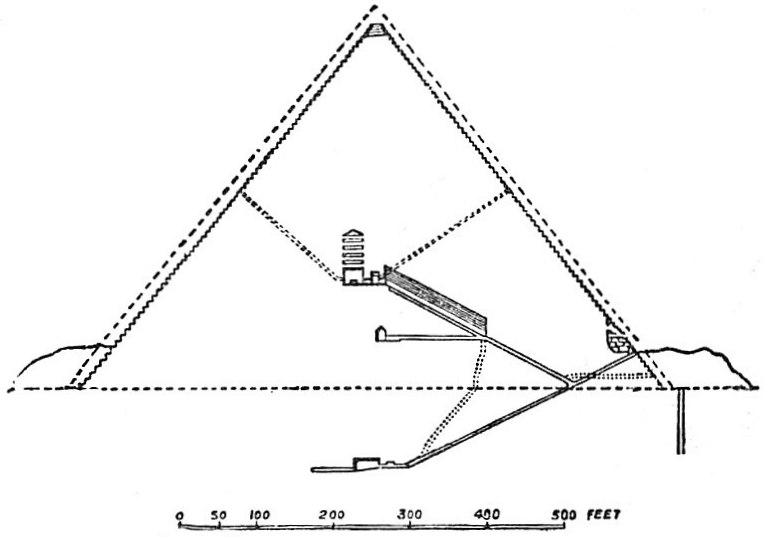 Pyramid chart from 1911 Bible Students Convention.
The most significant — and most revealing — aspect of Russell's pyramidology is how the measurements changed between editions of Thy Kingdom Come to accommodate shifting prophetic expectations.
The 1897 Edition: Pointing to 1874
In the 1897 edition of Thy Kingdom Come (p. 342), Russell wrote:
"So, then, if we measure backward down the 'First Ascending Passage' to its junction with the 'Entrance Passage,' we shall have a fixed date to mark upon the downward passage. This measure is 1542 inches, and indicates the year B.C. 1542, as the date at that point. Then measuring down the 'Entrance Passage' from that point, to find the distance to the entrance of the 'Pit,' representing the great trouble and destruction with which this age is to close, when evil will be overthrown from power, we find it to be 3416 inches, symbolizing 3416 years from the above date, B.C. 1542. This calculation shows A.D. 1874 as marking the beginning of the period of trouble; for 1542 years B.C. plus 1874 years A.D. equals 3416."
The Revised Edition (1905/1910): Pointing to 1914
After 1874 passed without the expected trouble materializing, and as 1914 became the new focal date for Russell's prophecies, the passage measurement was conveniently revised. In later editions (the change appeared as early as the 1905 edition), the same passage — as transcribed by critics of the Watchtower, pending confirmation against a primary edition — read:
"…we find it to be 3457 inches, symbolizing 3457 years from the above date, B.C. 1542. This calculation shows A.D. 1915 as marking the beginning of the period of trouble; for 1542 years B.C. plus 1915 years A.D. equals 3457. Thus the Pyramid witnesses that the close of 1914 will be the beginning of the time of trouble such as was not since there was a nation — no, nor shall ever be afterward."
(The internal "1915"-versus-"1914" wording reproduced above appears in critics' transcriptions; the exact phrasing should be checked against a scanned primary edition before being relied upon.)
| Edition | Passage Measurement | Date Calculated | Difference |
|---|---|---|---|
| 1897 | 3,416 pyramid inches | 1874 — beginning of trouble | — |
| 1905/1910 | 3,457 pyramid inches | 1914/1915 — beginning of trouble | +41 inches |
The Great Pyramid had apparently "grown" by 41 inches between editions. The stone passages of a 4,500-year-old monument did not change; Russell changed the numbers to match his revised chronology. According to earlychurch.net's analysis, the revised measurement was still 4 inches short of the actual measurements Smyth had published, meaning even the adjusted figure required rounding to make the math work.[3]
Additional Pyramid Dates
Russell derived several other dates from pyramid measurements, linking various architectural features to events in his prophetic timeline:
| Pyramid Feature | Measurement | Prophetic Interpretation |
|---|---|---|
| First Ascending Passage length | 1,542 pyramid inches | 1542 B.C. — giving of the Mosaic Law |
| Entrance Passage to Pit | 3,416 / 3,457 inches (revised) | 1874 / 1914 — beginning of trouble |
| Grand Gallery measurement (a) | 1,874 pyramid inches | 1874 A.D. — Christ's invisible return |
| Grand Gallery measurement (b) | 1,881 pyramid inches | 1881 A.D. — establishment of the Watch Tower Society |
| Grand Gallery measurement (c) | 1,910 pyramid inches | 1910 A.D. — significance unclear |
The correlations between these measurements and Russell's pre-existing dates suggest the method: measurements that happened to match dates already derived from his biblical chronology (primarily from Nelson Barbour's system) were selected, and the pyramid was then presented as "independent confirmation."
Symbols: The Cross and Crown, Winged Disk, and Pyramid Monument
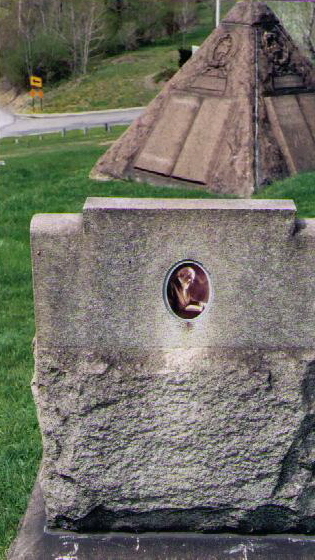 Pyramid monument near Russell's grave. Photo by Dtbrown, Wikimedia Commons.
Early Watchtower publications featured several symbols that have since become sources of controversy:
The Cross and Crown: The cover of The Watch Tower magazine displayed the Cross and Crown symbol from the magazine's earliest issues until 1931. Bible Students wore Cross and Crown pins as religious ornaments. The symbol is also associated with the Masonic order of the Knights Templar, though it was widely used by many Christian groups in the 19th century and is not exclusively Masonic. The Watchtower abandoned the Cross and Crown in the early 1930s, and by 1934 the cross itself was declared a pagan symbol.
The Winged Sun Disk: Later editions of Studies in the Scriptures featured a winged solar disk on the front cover. Russell's use derived from his reading of Malachi 4:2 — "the sun of righteousness will certainly shine forth, with healing in its wings" — though the symbol is primarily associated with the Egyptian god Ra and is used in Masonic and occult traditions. The choice is notable given that the organization now condemns all symbols with pagan origins.
Russell's Grave Pyramid: After Russell's death in 1916, the Watch Tower Society erected a seven-foot-tall pyramid memorial near his grave at Rosemont United Cemetery, 226 Cemetery Lane, Pittsburgh, Pennsylvania, in 1921. The pyramid bore the inscription "Watch Tower Bible And Tract Society" and featured the Cross and Crown symbol. It stood as a physical testament to the Bible Students' belief in the prophetic significance of the Great Pyramid. The monument was vandalized and reportedly removed in September 2021.[5]
Was Russell a Freemason?
The question of Russell's Masonic connections has generated extensive debate. The evidence:
Against Masonic membership: Russell is not found in any known Lodge registry. The Grand Lodge of British Columbia and Yukon has stated that Russell was not a Freemason. Russell himself said in 1913: "Although I have never been a Mason … Something I do seems to be the same as Masons do, I don't know what it is." He described Freemasonry, Knights of Pythias, and Theosophy as "grievous evils" and "unclean."
Circumstantial connections: The symbols used in early Watchtower publications (Cross and Crown, winged sun disk, pyramid imagery, references to "Knights Templar") overlap significantly with Masonic symbolism. Russell gave a speech in which he compared Bible Students favorably with Masons: "Do our Masonic friends understand something about the Temple, and being Knights Templars, and so on? We more." The pyramid memorial at his grave incorporates the Cross and Crown — a Knights Templar symbol — and overlooks a Masonic temple.
The most balanced assessment is that Russell was likely not a formal Freemason, but that he drew on a shared pool of 19th-century esoteric, Adventist, and pseudo-scientific ideas that also influenced Freemasonry. The symbols were common to multiple movements of the era and are not conclusive evidence of lodge membership.[6]
From "God's Stone Witness" to "Satan's Bible"
The Watchtower's treatment of pyramidology went through three distinct stages:
Stage 1 (1881–1916): Russell's promotion. Russell taught pyramidology as divine truth, calling the Great Pyramid "God's Stone Witness and Prophet." It was a central element of his prophetic framework and occupied an entire chapter of Studies in the Scriptures.
Stage 2 (1916–1928): Rutherford's continuation. After Russell's death, Joseph Rutherford initially continued promoting pyramidological teachings. The 1921 erection of the pyramid monument at Russell's grave occurred under Rutherford's presidency. As late as 1924, The Golden Age magazine included discussion of the pyramid as proof of God's "overruling of earth's affairs."
Stage 3 (1928–present): Condemnation. In the November 15, 1928 issue of The Watchtower (p. 344), Rutherford reversed course entirely: "If the pyramid is not mentioned in the Bible, then following its teachings is being led by vain philosophy and false science and not following after Christ." The pyramid was now deemed "Satan's Bible." In the 1933 book Preparation, pyramid study was listed alongside other "idols" to be "cut off and put away." The John and Morton Edgar brothers — Scottish Bible Students who had devoted years to pyramid research under Russell's encouragement — found their life's work suddenly condemned as demonic.[7]
The reversal raises a question the organization has not directly addressed: if the pyramid was "Satan's Bible" all along, why did God's supposedly chosen "faithful and discreet slave" promote it as divine truth for nearly five decades? And why, according to the organization's own timeline, did Jesus not correct this teaching when he supposedly inspected and approved the organization in 1919?
The Erasure: What Modern Witnesses Don't Know
The Watchtower has systematically minimized this history in its modern publications:
- The 1993 official history, Jehovah's Witnesses — Proclaimers of God's Kingdom, mentioned pyramidology only briefly, stating that "some" Bible Students had "become engrossed with pyramid measurements" — obscuring the fact that it was Russell himself who introduced and promoted the teaching
- A 2000 Watchtower article referenced Russell's pyramid chart but attributed the belief to unnamed "Bible Students" rather than to the organization's founder
- The 1955 book Qualified to Be Ministers acknowledged pyramidology had been taught but framed it as an inherited error quickly corrected — omitting the 47 years during which it was promoted as God's truth
Why It Matters
Pyramidology is not merely a historical curiosity. It matters because:
1914 was partly derived from pyramid measurements. The year that anchors the entire Jehovah's Witness prophetic framework — the year Christ supposedly began ruling invisibly, the year that determines the "this generation" doctrine, the year that the Governing Body claims validates its authority — was "confirmed" using the same pseudo-scientific methodology that the organization now condemns as satanic.
It establishes a pattern. The cycle of confident assertion → failed prediction → quiet revision → historical erasure that characterizes pyramidology is the same cycle that would repeat with 1925, 1975, the generation doctrine, and dozens of other doctrinal reversals.
It raises questions about the "faithful and discreet slave" claim. The organization claims that Jesus inspected all Christian groups in 1918–1919 and selected the Bible Students as his faithful and discreet slave based on the quality of the "spiritual food" they were providing. In 1919, that spiritual food included pyramidology — a teaching the organization would later call "Satan's Bible."[9]
See Also
- Charles Taze Russell (1852–1916) — The man behind the pyramid
- Adventist Roots & Precursors — The tradition from which pyramidology came
- Joseph Franklin Rutherford (1869–1942) — The man who reversed it
- Complete Timeline of Watchtower Prophecy Failures — 1874, 1914, and beyond
- The 607 BCE / 1914 Chronology Problem — The date pyramidology was used to "confirm"
- Major Doctrinal Reversals — Complete Registry — From God's truth to Satan's Bible
References
1. ↩ Pyramidology origins: M. James Penton, "A Case of Science, Pseudo-Science and Religion: Pyramidology in the Adventist-Bible Student Tradition" (SMU); Charles Piazzi Smyth, Our Inheritance in the Great Pyramid (1864); Joseph Seiss, A Miracle in Stone (1877); George Storrs influence documented in Herald of Life and the Coming Kingdom. [physics.smu.edu]
2. ↩ Russell's pyramid teachings: Studies in the Scriptures, Vol. III: Thy Kingdom Come (1891), Chapter 10; Isaiah 19:19–20 as proof text; Smyth's approval. Wikipedia, "Charles Taze Russell." [en.wikipedia.org]
3. ↩ Measurement revision: 1897 edition (p. 342): 3,416 inches → 1874; revised edition: 3,457 inches → 1914/1915. "41-inch" growth documented at earlychurch.net, "Russell and The Great Pyramid"; daenglund.com, "The Great Pyramid: God's Stone Witness to 1914"; JWCult.com. [earlychurch.net]
4. ↩ Additional pyramid dates: Studies in the Scriptures, Vol. III, pp. 342, 363 (various editions); measurements (a) 1,874, (b) 1,881, (c) 1,910 pyramid inches from Prof. Smyth's calculations applied by Russell. JWfacts.com, "Watchtower, Adventists & Freemasonry." [jwfacts.com]
5. ↩ Symbols: Cross and Crown on Watch Tower cover until 1931; winged sun disk on Studies in the Scriptures covers; Malachi 4:2 justification. Pyramid monument erected 1921 at Rosemont United Cemetery, 226 Cemetery Lane, Pittsburgh. Wikipedia, "Charles Taze Russell"; JWfacts.com, "Watchtower, Adventists & Freemasonry Connections." [jwfacts.com]
6. ↩ Freemasonry question: Russell's 1913 San Francisco speech ("Although I have never been a Mason…"); Grand Lodge of British Columbia and Yukon statement; Russell's "Masonic friends" speech comparing Bible Students to Knights Templars. Wikipedia; JWfacts.com, "Evidence that points to the fact that Charles Taze Russell was not a Freemason." [jwfacts.com]
7. ↩ Three stages: Stage 1 (1881–1916) — Russell; Stage 2 (1916–1928) — Rutherford continues, pyramid monument erected 1921, Golden Age 1924; Stage 3 (1928) — Watchtower, Nov 15, 1928, p. 344: "Satan's Bible." Preparation (1933), p. 239: pyramid as "idol." [daenglund.com]
8. ↩ Modern erasure: Jehovah's Witnesses — Proclaimers of God's Kingdom (1993); Watchtower 2000 study article; Qualified to Be Ministers (1955), p. 304. Analysis at Six Screens of the Watchtower, "Pyramidology." [sixscreensofthewatchtower.com]
9. ↩ "Faithful and discreet slave" inspection problem: if Jesus selected the Bible Students in 1919 based on the spiritual food being served, that food included pyramidology — later condemned as satanic. See The 'Faithful and Discreet Slave' — Shifting Identity. [jwfacts.com]