Raymond Franz & Crisis of Conscience
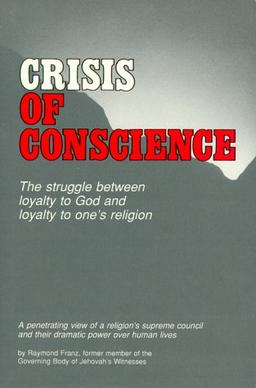 Cover of 'Crisis of Conscience' by Raymond Franz, 1983.
Raymond Victor Franz (May 8, 1922 – June 2, 2010) was a third-generation Jehovah's Witness who served at every level of the organization — from full-time pioneer to missionary to headquarters writer to member of the Governing Body itself. For nine years he sat in the room where the most powerful decisions in the organization were made. What he witnessed there — what he described as dogmatism, political maneuvering, the enforcement of teachings the leadership had doubts about, and the prioritization of institutional loyalty over biblical truth — shattered his faith in the organization, though not in God. His forced resignation in 1980, his disfellowshipping in 1981, and his subsequent books — Crisis of Conscience (1983) and In Search of Christian Freedom (1991) — constitute the most significant insider account ever written about the Watchtower organization.
Early Life and Family
Raymond Franz was born on May 8, 1922, in Cincinnati, Ohio, into a family deeply embedded in the Bible Student / Jehovah's Witness tradition. His father had been baptized as a Bible Student in 1913 — before the organization even adopted the name "Jehovah's Witnesses" in 1931.[1]
His uncle, Frederick William Franz, would become the most influential theologian in the organization's history — the architect of the 1975 prophecy, the principal translator of the New World Translation, and eventually the fourth president of the Watch Tower Society. The uncle-nephew relationship would prove fateful: Frederick Franz's power simultaneously elevated Raymond's career and made his eventual departure an act of profound personal cost.
Raymond joined the Jehovah's Witnesses in 1938 at age sixteen and was baptized in 1939. By 1940, he had entered full-time evangelizing service.[2]
Missionary Career (1944–1965)
In 1944, Franz graduated from the Watchtower Bible School of Gilead — the organization's elite training program for missionaries. He temporarily served as a traveling representative in the continental United States before receiving a missionary assignment to Puerto Rico in 1946.[3]
For nearly two decades, Franz served as a missionary and representative throughout the Caribbean — the Virgin Islands, Puerto Rico, and the Dominican Republic. His work continued until 1957, when Jehovah's Witnesses were banned in the Dominican Republic by dictator Rafael Trujillo.[4]
At age 37, Franz married Cynthia Badame on February 28, 1959. She joined him in missionary work, and together they returned to the Dominican Republic in 1961 after the ban was lifted, serving there for four more years.[5]
By this point, Raymond Franz had spent over twenty years in full-time service — a record of dedication that made his later departure particularly notable.
Coping with toxic family dynamics, estrangement, and rebuilding your life. For anyone dealing with the fallout of leaving a high-control group.
View on Amazon →Bethel Headquarters and Aid to Bible Understanding (1965–1971)
In 1965, Watch Tower Society President Nathan Knorr invited Franz to work and live at the organization's world headquarters (Bethel) in Brooklyn, New York. Franz later recalled that he would have preferred to continue missionary work but accepted the assignment at Knorr's request.[6]
Franz was assigned to the Writing Department, where he was given the principal role in producing Aid to Bible Understanding — the first encyclopedic reference work published by Jehovah's Witnesses. The project, which would eventually span five years (1966–1971) and produce a 1,700-page volume, required Franz and his team to conduct intensive research into biblical history, chronology, geography, and doctrine.[7]
It was during this research that the seeds of Franz's disillusionment were planted. The Aid project forced him to examine the organization's doctrinal positions against the actual biblical and historical evidence. He discovered that the foundational chronology behind the organization's most important date — 607 B.C.E. as the date of Jerusalem's destruction (which underpins the entire 1914 doctrine) — was not supported by any secular historical evidence. Every ancient source pointed to 587/586 B.C.E. as the actual date.[8]
Franz also became aware of the arbitrary nature of many doctrinal positions — including the distinction between "acceptable" and "unacceptable" forms of alternative military service, which varied by country with no consistent biblical basis.[9]
Despite these growing concerns, the Aid to Bible Understanding was published to great internal acclaim and is widely regarded as the most intellectually serious reference work the organization has ever produced. The irony is that the research demanded by the project ultimately led its principal author out of the organization.
Governing Body Member (1971–1980)
On October 20, 1971, Raymond Franz was appointed as one of the original members of the newly formalized Governing Body of Jehovah's Witnesses. He was one of eleven men who would direct the religious lives of millions of people worldwide.[10]
What He Witnessed
Franz served on the Governing Body for nearly nine years. During this period, he participated in the body's weekly deliberations on doctrinal matters, judicial policies, and organizational direction. What he observed profoundly disturbed him:
Doctrinal decisions driven by tradition, not Scripture. Franz described a process in which positions were maintained not because the Bible supported them, but because changing them would undermine the organization's authority or require admitting past error. The two-thirds supermajority required for doctrinal changes meant that a minority of members could block reforms indefinitely.[11]
The 1975 aftermath. Franz witnessed firsthand how the Governing Body handled the 1975 prophecy failure. The March 15, 1980 Watchtower that finally acknowledged the organization's role in building expectations about 1975 specifically referenced "persons having to do with the publication of the information that contributed to the buildup of hopes centered on that date" — language that Franz understood as pointing at him, since he had chaired the Writing Committee. According to Franz, the 1975 expectations were primarily driven by his uncle Frederick Franz, who authored Life Everlasting in Freedom of the Sons of God and delivered the convention talks. Raymond Franz had been left to absorb blame for a prediction he had not originated.[12]
Political maneuvering over principle. Franz described Governing Body sessions where the stated reason for a policy bore little relationship to the actual motivations behind it. He recounted how the body's deliberations were shaped by personal influence, seniority, and institutional inertia rather than careful biblical exegesis.[13]
The gap between public claims and private reality. The organization publicly claimed to be directed by holy spirit. According to Franz, he privately witnessed decisions made through political negotiation, personal prejudice, and organizational expedience — the same human processes that govern any large institution.[14]
The Breaking Point
By the end of 1979, Franz had reached what he described as a personal crossroad:
"I had spent nearly forty years as a full time representative, serving at every level of the organizational structure. The last fifteen years I had spent at the international headquarters, and the final nine of those as a member of the worldwide Governing Body of Jehovah's Witnesses. It was those final years that were the crucial period for me. Illusions there met up with reality."[15]
He later reflected: "I now began to realize how large a measure of what I had based my entire adult life course on was just that — a myth: persistent, persuasive, and unrealistic."[16]
The 1980 Purge
Departure from Headquarters
In March 1980, Franz and his wife Cynthia took a leave of absence from world headquarters for health reasons and moved to Alabama, where he took up laboring work on a property owned by a fellow Witness. He had quietly decided to step away from headquarters life.[17]
But as subsequent events would show, the Governing Body did not allow dissenters to leave quietly.
The Inquisition
In April 1980, a committee of the Governing Body began investigating reports of "wrong teachings" being discussed by headquarters staff. Bethel workers were interrogated about their personal beliefs and about comments Raymond Franz had made that may have contradicted Watch Tower doctrine.[18]
On May 8, 1980 — his fifty-eighth birthday — Franz was told he had been implicated as an apostate. On May 20, he was called back to Brooklyn for two days of questioning by the Chairman's Committee. On May 21, he was brought before a full Governing Body session and questioned for three hours about his biblical viewpoints and his commitment to Watch Tower doctrines.[19]
Forced Resignation: May 22, 1980
On May 22, 1980, Franz agreed to resign from the Governing Body and the headquarters staff. The August 1980 Our Kingdom Ministry carried a terse announcement: "This is a notification that Raymond Victor Franz is no longer a member of the Governing Body and of the Brooklyn Bethel family as of May 22, 1980."[20]
Franz refused the Watch Tower Society's offer of a monthly stipend as a member of the "Infirm Special Pioneers" — a classification that would have kept him financially dependent on the organization and subject to its authority.[21]
The September 1980 Policy: Criminalizing Private Belief
The Governing Body used the Franz affair to establish a sweeping new policy. On September 1, 1980, a letter was distributed to all Circuit and District overseers stating that apostasy need not involve actively teaching contrary doctrines. Individuals who privately believed teachings that differed from the Watch Tower Society's positions — even if they never shared those beliefs with anyone — were committing apostasy and were subject to disfellowshipping.[22]
This was a watershed moment. For the first time, the organization officially claimed jurisdiction not just over members' words and actions, but over their thoughts. Private belief became a punishable offense.
Disfellowshipping: November 20, 1981
After his resignation, Franz and Cynthia continued living in Alabama. On March 18, 1981, Franz's employer — a fellow Witness named Peter Gregerson — submitted a letter of disassociation from Jehovah's Witnesses. Under the organization's rules, Gregerson was now to be shunned.[23]
On November 20, 1981, Raymond Franz was disfellowshipped. The stated reason: he had been observed sharing a meal with Peter Gregerson — a disassociated person. Under the organization's shunning policy, eating with a former member constituted a disfellowshipping offense.[24]
A man who had given forty years of full-time service — who had served as a missionary, written the organization's first encyclopedia, and sat on its highest governing body — was expelled and cut off from all family and friends within the organization for eating lunch with his employer.
Crisis of Conscience (1983)
In 1983, Franz published Crisis of Conscience, a 443-page memoir that detailed his experiences within the Governing Body and the events leading to his expulsion. The book was published by Commentary Press and has since gone through multiple editions and translations.[25]
What the Book Reveals
Crisis of Conscience is not a polemical attack. It is a measured, documented, first-person account of how the organization's highest leadership body actually functions. Among its most significant revelations:
Governing Body deliberations. Franz reproduced extensive notes, letters, and memoranda from his time on the Governing Body, showing how doctrinal decisions were made through political negotiation rather than careful biblical study. He documented instances where the body continued to enforce teachings that its own members privately doubted.[26]
The 607 B.C.E. problem. Franz documented his research showing that no ancient historical source — Babylonian, Egyptian, Persian, or otherwise — supports the organization's date of 607 B.C.E. for the destruction of Jerusalem. He described how the Governing Body chose to maintain the date despite the evidence because abandoning it would unravel the entire 1914 framework and with it, the organization's claim to divine appointment.[27]
The 1975 blame game. Franz provided a detailed account of how Frederick Franz — not the Writing Committee — was the primary driver of the 1975 expectations, and how the Governing Body subsequently deflected blame onto both the membership and the Writing Committee.[28]
The alternative service controversy. Franz described the Governing Body's extended deliberations over whether Witnesses could accept civilian alternative service instead of going to prison for refusing military conscription. Despite a clear majority favoring a change, the two-thirds supermajority rule meant that thousands of young Witnesses continued to go to prison for years while the body failed to reach the threshold for a policy change. When the change finally came (1996), no acknowledgment was made of the years of unnecessary imprisonment that the prior policy had caused.[29]
The nature of organizational authority. Perhaps most fundamentally, Franz documented what he described as a disconnect between the organization's public claims — that it is directed by God through holy spirit, that its positions are based on Scripture, and that its leadership selflessly serves the flock — and what he characterized as a reality of institutional self-preservation, political calculation, and the enforcement of conformity through fear.
Impact
Crisis of Conscience has been translated into numerous languages and has been continuously in print for over four decades. For thousands of Jehovah's Witnesses experiencing doubts, it has served as the essential document confirming that the questions they were asking were legitimate — and that the organization's highest leaders shared those same questions behind closed doors.[30]
The Watchtower organization has never publicly responded to the specific claims in the book, though it has published numerous articles warning against "apostate literature" and characterizing former members who speak out as mentally diseased agents of Satan.[31]
In Search of Christian Freedom (1991)
In 1991, Franz published his second book, In Search of Christian Freedom, a more extensive and systematic examination of Watchtower doctrine and practice. At over 700 pages, it provides a comprehensive analysis of the organization's authority claims, its treatment of Scripture, its judicial processes, and its impact on the lives of ordinary members.[32]
Where Crisis of Conscience is primarily a personal memoir with doctrinal implications, In Search of Christian Freedom is primarily a doctrinal and organizational analysis with personal elements. Together, the two books constitute the most thorough insider critique of the Watchtower organization ever published.
Legacy
Raymond Franz did not become an atheist, an agnostic, or a member of another religion. He maintained a personal Christian faith until his death, rejecting organized religious structures while affirming what he understood to be the core message of the New Testament — a faith centered on a personal relationship with Christ rather than obedience to a human organization.[33]
His influence on the ExJW community is difficult to overstate. Crisis of Conscience is widely regarded as the single most important book for Jehovah's Witnesses going through the process of questioning and leaving the organization. It has been cited by countless former Witnesses as the book that confirmed their doubts and gave them permission to think for themselves.[34]
For the Watchtower organization, Franz presents a difficult case: here was a man who served faithfully for four decades, who reached the highest level of the organization, who had access to all of its inner workings — and who concluded, on the basis of that access, that the organization's central claims about itself were not true. The organization's response has been to label him an apostate and discourage members from reading his work.
Death
Raymond Franz died on June 2, 2010, at age 88, reportedly following a fall that resulted in a brain hemorrhage. His wife Cynthia, who had shared his entire journey — from missionary service through Bethel to the Governing Body to expulsion — had preceded him in death on May 15, 2010, just eighteen days earlier.[35]
Timeline
| Date | Event |
|---|---|
| May 8, 1922 | Born in Cincinnati, Ohio; third-generation Jehovah's Witness |
| 1938 | Joins Jehovah's Witnesses at age 16 |
| 1939 | Baptized |
| 1944 | Graduates from Gilead Missionary School |
| 1946 | Assigned as missionary to Puerto Rico; begins nearly two decades of Caribbean service |
| Feb. 28, 1959 | Marries Cynthia Badame at age 37 |
| 1965 | Invited by Nathan Knorr to serve at Bethel headquarters in Brooklyn, New York |
| 1966–1971 | Principal writer of Aid to Bible Understanding; research exposes doctrinal problems including the 607 B.C.E. chronology |
| Oct. 20, 1971 | Appointed to the newly formalized Governing Body of Jehovah's Witnesses[10] |
| 1971–1979 | Serves on the Governing Body; witnesses internal decision-making firsthand; growing disillusionment |
| Mar. 1980 | Takes leave of absence from headquarters; moves to Alabama |
| Apr.–May 1980 | Governing Body investigation targets "wrong teachings" at headquarters; staff interrogated about beliefs |
| May 21, 1980 | Questioned for three hours before full Governing Body session |
| May 22, 1980 | Resigns from Governing Body and Bethel staff[20] |
| Sep. 1, 1980 | Governing Body letter criminalizes private disbelief as apostasy[22] |
| Nov. 20, 1981 | Disfellowshipped for sharing a meal with a disassociated person[24] |
| 1983 | Crisis of Conscience published by Commentary Press[25] |
| 1991 | In Search of Christian Freedom published[32] |
| May 15, 2010 | Cynthia Franz dies |
| June 2, 2010 | Raymond Franz dies at age 88 following a fall[35] |
See Also
- The Governing Body — Structure, History & Power — The body Franz served on and exposed
- Frederick William Franz (1893–1992) — Raymond's uncle, the organization's chief theologian
- The 1980 Bethel Purge — The broader crackdown that accompanied Franz's removal
- The 1975 Prophecy Catastrophe — The failed prediction Franz witnessed from inside the Governing Body
- The 607 BCE / 1914 Chronology Problem — The historical error Franz documented during the Aid project
- Disfellowshipping & Shunning — The policy used to cut Franz off from his lifelong community
- The ExJW Movement — The community Franz helped create through his writings
References
1. ↩ "Raymond Franz," Wikipedia: father baptized in 1913 as a Bible Student. [en.wikipedia.org]
2. ↩ "Raymond Franz," Wikipedia: joined 1938, baptized 1939, full-time service by 1940. [en.wikipedia.org]
3. ↩ "Raymond Franz," Wikipedia: graduated Gilead 1944; assigned to Puerto Rico 1946. [en.wikipedia.org]
4. ↩ "Raymond Franz," Wikipedia: served in Virgin Islands, Dominican Republic; banned under Trujillo 1957. [en.wikipedia.org]
5. ↩ "Raymond Franz," Wikipedia: married Cynthia Badame February 28, 1959; returned to Dominican Republic 1961. [en.wikipedia.org]
6. ↩ "Raymond Franz: former Jehovah's Witness," exjw.org.uk: Franz preferred missionary work but accepted Knorr's invitation. [exjw.org.uk]
7. ↩ "Raymond Franz," Wikipedia: assigned to collaboratively write Aid to Bible Understanding, the first religious encyclopedia published by Jehovah's Witnesses. [en.wikipedia.org]
8. ↩ Raymond Franz, Crisis of Conscience (Commentary Press, 1983; 3rd ed. 2000): extensive documentation of the 607 B.C.E. research problem.
9. ↩ Raymond Franz, Crisis of Conscience: describes the alternative service controversy and inconsistencies between countries.
10. ↩ "Raymond Franz," Wikipedia: appointed to Governing Body October 20, 1971. [en.wikipedia.org]
11. ↩ Raymond Franz, Crisis of Conscience, pp. 42–108: describes how Governing Body decisions were driven by tradition and political calculation. [en.wikipedia.org]
12. ↩ "Raymond Franz," Wikipedia: the March 15, 1980 Watchtower statement that blamed "persons having to do with the publication of the information" precipitated a purge of the Writing Committee. [en.wikipedia.org]
13. ↩ Raymond Franz, Crisis of Conscience: detailed accounts of Governing Body sessions including personal influence and institutional inertia.
14. ↩ "Governing Body of Jehovah's Witnesses," Grokipedia: Franz detailed how decision-making processes often lacked broad input or rigorous research. [grokipedia.com]
15. ↩ Raymond Franz, Crisis of Conscience (2000 ed.), Introduction. [en.wikipedia.org]
16. ↩ Raymond Franz, Crisis of Conscience: "The great enemy of the truth is very often not the lie... but the myth — persistent, persuasive and unrealistic." [findagrave.com]
17. ↩ "Raymond Franz," Wikipedia: moved to Alabama in March 1980; took up laboring work on a property owned by a fellow Witness. [en.wikipedia.org]
18. ↩ "Raymond Franz," Wikipedia: April 1980 investigation; staff questioned about beliefs and Franz's comments. [en.wikipedia.org]
19. ↩ "Raymond Franz," Wikipedia: May 8 implicated as apostate; May 21 questioned for three hours before full Governing Body. [en.wikipedia.org]
20. ↩ Our Kingdom Ministry, August 1980, p. 2, "Announcements": "This is a notification that Raymond Victor Franz is no longer a member of the Governing Body and of the Brooklyn Bethel family as of May 22, 1980." [en.wikipedia.org]
21. ↩ "Raymond Franz," Wikipedia: refused the Watch Tower Society's offer of a monthly stipend. [en.wikipedia.org]
22. ↩ September 1, 1980 letter to all Circuit and District overseers: individuals who privately believe doctrines contrary to the Watch Tower Society's teachings are committing apostasy and subject to disfellowshipping. [en.wikipedia.org]
23. ↩ "Raymond Franz," Wikipedia: Peter Gregerson submitted disassociation letter March 18, 1981. [en.wikipedia.org]
24. ↩ "Raymond Franz," Wikipedia: disfellowshipped November 20, 1981 for sharing a meal with a disassociated person. [en.wikipedia.org]
25. ↩ Raymond Franz, Crisis of Conscience (Commentary Press, 1983). Subsequent editions: 2nd ed. 1992, 3rd ed. 2000, 4th ed. 2004.
26. ↩ Raymond Franz, Crisis of Conscience: reproduced extensive notes, letters, and memoranda from Governing Body deliberations.
27. ↩ Raymond Franz, Crisis of Conscience, chapter on chronology: documented that no ancient historical source supports 607 B.C.E.
28. ↩ Raymond Franz, Crisis of Conscience: detailed account of Frederick Franz's role as the primary architect of the 1975 expectations.
29. ↩ Raymond Franz, Crisis of Conscience: describes the alternative service debate; the two-thirds supermajority rule blocked change for years while Witnesses continued to be imprisoned. Policy finally changed in 1996.
30. ↩ Crisis of Conscience has been translated into numerous languages and continuously in print since 1983. Widely cited as the most important book in the ExJW community.
31. ↩ The Watchtower organization has published numerous warnings against "apostate literature" without directly naming Franz or responding to his specific claims. See The Watchtower, July 15, 2011: "apostates are mentally diseased."
32. ↩ Raymond Franz, In Search of Christian Freedom (Commentary Press, 1991). Over 700 pages of systematic doctrinal and organizational analysis.
33. ↩ Franz maintained a personal Christian faith after leaving the organization; he did not join another religious denomination. Crisis of Conscience, Afterword.
34. ↩ "Raymond Franz," JWfacts.com: Crisis of Conscience widely regarded as the single most important book for ExJWs. [jwfacts.com]
35. ↩ "Raymond Victor Franz (1922–2010)," Find a Grave: died June 2, 2010 from brain hemorrhage after a fall; Cynthia died May 15, 2010. [findagrave.com]