Watchtower Taught Jehovah's Witnesses NOT To Trust Watchtower
It's very easy for people to be manipulated by false information, especially if that information tends to agree with their own personal ideas.
That's Mark Sanderson, a member of the governing body of Jehovah's Witnesses, one of the men at the very top of the organization, warning millions of people about the danger of believing false information just because it fits what they already want to believe. He's right. He's completely right. That is exactly how manipulation works. What he doesn't tell his audience, whether he sees it or not, is that he has just described the Watchtower organization's methodology.
So I'm going to do the one thing he never does. I'm going through his talk in the order Watchtower released it, and I'm taking his actual test, the one he hands to Jehovah's Witnesses, and applying it to the organization itself. Every principle, every scripture, every warning. It does not go well for Watchtower.
Why This Talk Deserves a Point-by-Point Answer
I was a Jehovah's Witness until I was 40 years old, and I sat through thousands of talks built exactly like this one. I know the cadence, the rhetorical question, the little pauses, the "well," and then the conclusion handed to you pre-chewed so you can repeat it back. I'm not going to mock the man too much. He's a public figure making a public argument on the organization's website, and the argument deserves to be answered on its merits. This isn't an attack on Sanderson personally. It's a point-by-point answer to him using nothing but Watchtower's own published words.
The talk is called Protect Yourself from Misinformation. It's a morning worship talk recorded around the 2023 year text, so it isn't brand new, but it was dropped on jw.org for whatever reason, which is why people are suddenly talking about it. It runs about 10 minutes, and its stated purpose is to teach Jehovah's Witnesses how to evaluate information and avoid being deceived.
Watch what happens as we go through it. Every tool he hands you for spotting manipulation is a real tool. None of it is wrong. This whole rebuttal works precisely because the tools are good and, in my view, the organization fails its own tests.
Sanderson Says the Bible Is the Ultimate Standard
Our year text for 2023 is Psalm 119:160, which says, "The very essence of your word is truth." Well, that's true. Jehovah has truly benefited us by giving us his precious word of truth. That word is the ultimate standard for what is true and what is false.
Stop right there, because he's already given away the whole game. That word, the Bible, is the ultimate standard for what is true and false. Good. Hold them to that, because as I see it, inside this organization the Bible is not the ultimate standard. The governing body is. When the governing body's teachings and your own reading of the Bible collide, you're not told to follow the Bible as the highest authority. You're told to follow them. And they've said so in print, in their own Watchtower:
We will follow the direction we receive even if we do not fully understand all the reasons for it.
Now read that next to his opening line. The ultimate standard is supposed to be God's word, but the actual instruction is to follow the organization's direction even when you don't understand the reasons for it. That's not "the word is the standard." In effect, it's we are the standard, and we'll cite the word. His first segment already contradicts the organization that produced it.
In case you think this isn't as bad as I'm making it sound: in my view, the literal test of whether you are an apostate is whether you disagree with their teachings. Even if the Bible tells you that's the correct teaching, if you disagree with what the Watchtower teaches, you are an apostate, and you will be kicked out and shunned, losing your entire family, friends, and social network.
Easy Access to Information Doesn't Make It True
Well, now today we live in what's often called the information age. Before it may have taken many hours or even many days to find certain information. But now using an internet search engine after just a few minutes or in some cases maybe after just a few seconds we can have the information that we are seeking. But just because there's so much information available and it's so easy to access does not mean that that information is accurate, that it is reliable, or that it is based on truth.
Every word Sanderson just said is true, and every word of it describes Watchtower's own publishing history. For over a century, this organization put information in front of millions of people, confidently and authoritatively, as truth from God, and it turned out to be none of those things. It was available. It was easy to access. It came to your door. And it wasn't accurate.
1914 was going to bring the end. Then 1925: millions now living will never die. Then 1975. Each one was taught with total confidence. Each one was false. He's warning you that easy, confident, available information can still be untrue, and that's correct. He's just pointing that warning at Google and the internet instead of at the Watchtower on your own bookshelf.
I remember Watchtower gloating about how much information was available to Jehovah's Witnesses when the first JW Library app came out on CD-ROM. I actually built my own research tool that indexes pretty much everything Watchtower has ever written, all the way back to the first Watchtower magazine at the end of the 19th century. According to my tool's tally, Watchtower has written 167,625,843 words. That number may shift a little, because the tool updates itself every night. In my view, most of those words are nonsense. So yes, Sanderson is right. Easy access to mountains of information does not make that information true.
So far, he has established his standard of truth and warned that confidence and availability don't equal truth. By his own standard, the organization has a problem. It gets worse.
The Post-Truth Passage Describes the Kingdom Hall
Interesting that in late 2016, Oxford dictionaries selected post-truth as the word of the year. Now, what does this word post-truth mean? Well, it's said that it is defined as relating to a situation in which people are more likely to accept an argument based on their emotions and beliefs rather than one based on facts. Well, what does that mean? It means people choose to believe according to their feelings, their emotions or according to their own personal beliefs. Well, that means it's very easy for people to be manipulated by false information, especially if that information tends to agree with their own personal ideas.
This is the center of the talk, and I consider it the single most self-incriminating passage in it. Read it as a description of how someone becomes and stays a Jehovah's Witness.
You're recruited with an emotional promise: the paradise earth, your dead relatives coming back, an end to all suffering. You desperately want that to be true. Then every piece of information you're given confirms it, and every piece that doesn't is labeled as satanic and forbidden. It's very easy for people to be manipulated by false information, especially if it agrees with their own personal ideas. That's what Sanderson said, and he's correct. As I see it, he's describing the exact psychological machinery the organization runs on. He presents it as a description of the world, but it describes the Kingdom Hall.
And that's only half the machine. Confirmation bias on its own is just a human tendency. We all have it. It's not sinister. What turns a tendency into a trap is a system that feeds you only the confirming information and builds a wall around everything else. In my view, this organization does both at the same time. It supplies the emotionally irresistible belief, and then it criminalizes contact with anything that might test that belief. Sanderson warns his audience about the first half, the wanting-to-believe half, while the organization he represents quietly runs the second half on the very people in that same room. He's holding up a mirror and calling it a window.
Made-Up Coffee Headlines and Made-Up Prophecies
Now, let me give you an example. Here are three headlines. Now, which one seems to be true to you? Drinking three cups of coffee a day may lead to stomach cancer. Here's the second. Regular coffee drinking linked to longevity and lower risk of stroke. Here's the third study says, "Drink tea instead of coffee and you'll avoid heart disease." So, did any of these headlines seem to be true to you? Well, it's interesting that most people tend to believe the story that matches with their own personal ideas. So, if you like drinking coffee, you might have chosen the story that says drinking coffee is good for you. And if you don't like drinking coffee, and perhaps you even think it's dangerous, well, then you might have chosen the story that says coffee drinking is dangerous. And if you prefer to drink some kind of tea instead of coffee, well then you might have chosen the last story. Well, which one is true? Well, actually, none of these headlines are real. I made them all up just to try to illustrate this simple point that it's very easy to believe what we want to believe.
So Sanderson made up false information and presented it to millions of people in a talk about the danger of made-up false information. To be fair, he disclosed it. He told you he invented the headlines as an illustration. If only the Watchtower had been that transparent about all the false information it has put out over the years. That would have been a lot better for Jehovah's Witnesses, because they would have left. It would not have been better for Watchtower.
But in my view, the dangerous fabrications in the organization's history were never disclosed as illustrations. Nobody stood up in 1975 and said, "I'm making this up to prove a point." It was preached as fact, as the word of Jehovah, and people sold their homes and skipped having children over it. He just taught you to be suspicious of a made-up coffee headline. He never once taught you to be suspicious of a made-up prophecy, and in my view, they've done that many times. It's the same skill. He's just pointing it outward and not inward.
Proverbs 14:15 and the Member Who Actually Ponders
Well, how can the Bible benefit us? Obviously, the Bible does not touch on every matter that's involved in life, but it does give us principles that can help us to evaluate information so that we can discern whether something is true or it's false. Now, recently we had a very excellent article on the website entitled Protect Yourself from Misinformation. Let's consider a few of the Bible principles that were outlined in that article. Here's the first one. It's Proverbs 14 and verse 15. It says, "The naive person believes every word, but the shrewd one ponders each step." Well, now what does that mean? What does it mean he ponders? Well, one reference work says that this is a figure that means to be cautious, alert, or aware with the sense of being careful not to be misled by untruth. Well, that's very, very good advice.
It is very good advice. It's also, as I see it, word for word the opposite of what this organization demands of its members.
The naive person believes every word. But what is the Jehovah's Witness instructed to do with the governing body's words? Believe every one of them, even, in their own phrasing, when you don't understand the reasons. Even if that information seems to be dangerous. Yes, they really said that too.
The shrewd one ponders each step. That's what the Bible says. But the member who actually ponders, who pauses, checks, and asks the hard questions about a teaching, isn't praised by the organization as shrewd. That person is treated as a doubter, a danger, or an apostate. Sanderson is quoting a verse that commends questioning to an audience that gets shunned for doing it. The shrewd one inside this organization doesn't survive. The naive one gets baptized.
Watchtower's Deep Fakes Are Built With Scissors
There are so many false reports that are out in the world. In fact, now there's even something called deep fake videos. Have you heard about these? So, this is where they take video of a politician or perhaps some other well-known person and using technology they manipulate it so that the person seems to be saying something that they never ever said. Frightening. We have to be truly careful that we do not accept information on face value, especially if it tends to support some personal idea that we have.
Manipulated so the person seems to be saying something they never said. Hold on to that exact sentence, because in my view it's the precise definition of what Watchtower does to its sources.
Open any publication and you'll find quotations from scientists, historians, and scholars trimmed, clipped, and arranged so the expert seems to be supporting a Watchtower conclusion they actually reject. A doctor cited as doubting evolution turns out to have been talking about something else entirely. And don't get me started on the Trinity brochures and the massive number of misleading, cherry-picked quotes they used to make it look like people were supporting their position against the Trinity when they were saying the opposite.
I'm not telling you what to believe. If you don't believe in evolution or the Trinity, that's fine. I'm saying Watchtower's way of approaching the argument is intellectually dishonest. If you're going to quote somebody, quote them for what they said, in the direction they were trying to prove, not for the opposite thing you're trying to prove. As I see it, the organization has been making well-known people seem to say things they never said for decades. Sanderson used a word for it, deep fake, and handed his own members the tool to catch it, without once mentioning that the polished example of the technique in their lives is the literature on their own shelves.
It's worth being precise about how this trick works, because it's subtler than a lie. I've never known the organization to invent a quotation outright from an expert. It does something harder to catch. It takes a real sentence from an actual expert and strips away the surrounding context that would flip its meaning: the "however," the "but in fact," the next paragraph where the author concludes the exact opposite. The quote is usually genuinely that person's words, but the impression is altered. It's fabricated. That's the deep fake I'm talking about, built with scissors instead of software. He taught his audience to distrust a doctored video of a politician, but he never taught them to distrust the doctored paragraphs in their own literature, because that one works in the organization's favor.
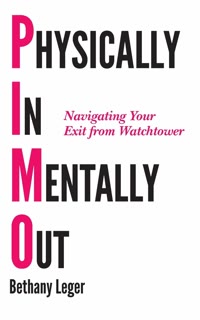
I also really wonder whether Sanderson is trying to plant the idea in witnesses' minds that any footage of witnesses caught on camera doing something against the rules is a fabrication. Remember former governing body member Tony Morris, good old Uncle Tony, in that liquor store on a Sunday morning instead of being at the Kingdom Hall? That's just me speculating, so don't take it as evidence of anything. But one guy on Reddit, a PIMO (physically in, mentally out, who still goes for whatever reason but doesn't believe), said an older sister at his hall used that as an example of a deep fake in a Watchtower comment. That made him wonder, and me too, whether she had actually seen that footage in order to think it was fake, and how she saw it. If those kinds of things are reaching the eyes of even elderly active Jehovah's Witnesses, Watchtower has got to know it's in trouble.
"Make Sure of All Things" Versus "Never Read Them"
Now, let's go to the next principle. It's 1 Thessalonians 5 and verse 21. 1 Thessalonians 5:21 says, "Make sure of all things. Hold fast to what is fine." Well, how can we make sure that something is true? Well, here's two questions that we can ask ourselves. Here's the first one. What is the source of this information? Be careful. A website might look very impressive. It might be beautifully formatted. It might have a very impressive name, but none of those things make the information true.
This is the one that should stop a thinking member in their tracks. Make sure of all things. Again, good advice. The Bible, his ultimate standard, commands the believer to verify everything, and this organization forbids doing exactly that. You're not permitted to make sure of the governing body's claims by checking them against any source it hasn't approved or doctored to quote from.
In fact, that same year, the organization released another talk in the same program, Protect Yourself from Apostasy. Here is its instruction about any information critical of Watchtower:
Treat them as the poison they are. Never read them, reply to them, or repeat them.
Put those two talks side by side, because they came out of the same organization in the same year. One says make sure of all things, what is the source, verify it all. The other says never read it, treat it as poison. You can't make sure of all things while being forbidden to read half of them. That's not a media literacy program. That's a quarantine.
The Cage and the Sharks
I want you to feel how total that quarantine is, because from the inside it never feels like one. It doesn't feel like censorship when you're a true believer. It feels like protection.
I remember one brother giving a talk where he described a person in a cage and asked whether you'd want to be in that cage. Of course the answer is no. Nobody wants to be in a cage. Then he asked: what if you were a deep sea diver and that cage was protecting you from the sharks outside? I thought that was a fantastic illustration at the time. It was a very clever way of making the cage feel like protection.
But in my view, the sharks are actually inside the cage. Watchtower's own publications, speakers, and leaders are the sharks. You want to be outside that cage so they can't get to you. Of course, they'll never put it that way.
You can't make sure of all things at the library, because the critical sources are supposedly apostate or from Babylon the Great. You're not supposed to go outside the cage. You can't make sure online, because independent sites are poison and Satan is trying to lure you away from God's organization. You can't even make sure by asking an elder a pointed question, because the question itself marks you as somebody who needs to be watched. The only sanctioned way to resolve a doubt about Watchtower is to go consult more Watchtower. That's not verification. It's the opposite of verification, wearing the one verse that commands verification as a costume.
Sanderson Just Described jw.org
Think about that statement again:
A website might look very impressive. It might be beautifully formatted. It might have a very impressive name, but none of those things make the information true.
He's describing jw.org: a very beautifully formatted, impressively named, professionally produced religious website, the one he wants you to trust absolutely and exclusively. But by his own test, in his own words, the polish of jw.org isn't evidence that what's on it is true. The multi-million-view dramatizations, the slick app, the production values: none of those things, in his own words, make that information true. He built the rule that disqualifies his own platform.
A List of Sources All Carrying the Same Misinformation
Here's a second one. Is the content current and accurate? See, look for dates in the information. Look for verifiable facts and strong evidence that the statements being made are actually true. But now, be careful because often the evidence that's provided for a certain statement may be a list of other websites that are all carrying the very same misinformation. So be cautious.
Here Sanderson describes Watchtower's sourcing model exactly. Often the evidence is a list of other websites all carrying the very same misinformation. Replace "websites" with "publications." How does the Watchtower support a Watchtower claim? It cites another Watchtower publication. You've probably seen them do this many times. The footnotes point inward. The talks point to other things other witness leaders said. It's a closed loop: a single organization citing only itself, or misquoting other people, and presenting that as verification.
And is the content current and accurate? This comes from an organization whose back catalog is a museum of expired predictions it has quietly walked back. You'll still very frequently see Watchtower reference very old publications that they say are God's truths. Jehovah's Witnesses are told to look for dates and verifiable facts everywhere except the one library they're actually required to believe.
Notice what keeps happening. Mark Sanderson hasn't been wrong about a single thing. The tools are sound. It's the direction he aims them that's the tell: always outward, at the world, the news, the search engines, social media. Never once at the lectern he's standing behind.
"Three Out of Four Doctors" and the Governing Body's Credentials
What about statements like this? Three out of four doctors support this product. Hmm, what does that actually mean? See, for example, say it meant that they had surveyed 1 million doctors and 750,000 or three out of four all agreed that this product was good and reliable. Well, that would be significant, but it could also mean that they talked to eight doctors and six of them agreed that the product was accurate or good. Are those two things the same? Well, obviously not. Make sure what you're actually reading. And then two, what type of doctors were they? They're doctors of history, doctors of philosophy, doctors of law. There's even doctors of veterinary medicine. Be careful. Information can be packaged so that it sounds believable and authoritative. Make sure that you have the facts.
This is a genuinely sharp lesson in how authority gets faked, and in my view it's a perfect description of how the organization manufactures its own authority. Information can be packaged so it sounds believable and authoritative. As I see it, that's the entire production design of the governing body: a group of men with no theological degrees and no formal credentials, presented to millions of people as the sole channel of communication from Almighty God.
What type of doctors were they? It's a good question, and it's the exact question no witness is allowed to ask about the men at the top of the organization. Their authority is packaging. And based on my research, even the packaging doesn't hold: Watchtower claims the governing body runs the organization, and I don't believe that's true at all. Other people do. Sanderson just taught you to see through packaging, and then asked you not to look at his.
Proverbs 28:26: Who Really Trusts His Own Heart?
Let's go to the third principle. It's Proverbs 28 and verse 26. Proverbs 28:26 says, "Whoever trusts in his own heart is stupid." Wow, that's a pretty strong language, isn't it? But that's what the Bible says. The website article says we tend to trust information that confirms what we want to believe. Well, that means we have to ask ourselves this question. Do I trust this information just because it's what I want to believe?
Watch the move here, because I think it's the most important one in the talk. He takes a verse about self-deception and aims it at the individual member's heart. Don't trust your own feelings, your own reasoning, your own conscience. And inside this organization, that is exactly how Proverbs 28:26 gets used. When your gut tells you something is wrong, the answer is that your heart is stupid and treacherous and you should defer to the organization instead, even though they're also human beings possessing stupid and treacherous hearts.
But turn the verse around one degree. Whoever trusts in his own heart is stupid. Who in this entire structure trusts their own heart the most? A group of men who, in my view, take their own interpretations as divine law, as scripture. Their own readings and their own changing conclusions are presented to the world as the mind of God. The verse he's using to silence your conscience is a far better description of the men using it.
Exodus 23:1: "You Must Not Spread a Report That Is Not True"
Here's the fourth and last principle. It's Exodus 23 and verse one. It says there, "You must not spread a report that is not true." That's very strong language, isn't it? Very clear. What's the point? We have a very important responsibility not to share information unless we know for a certainty that it's true. In many cases, it's far better to hit the delete key than to hit the send button.
There's the line. Sit with that for a second, because it's the closest this organization has ever come to speaking its own indictment out loud. Do not share information unless you know for a certainty that it's true. That is excellent advice, and impossible to take seriously from an organization like Watchtower.
It told its members the world would end in 1914. It published Millions Now Living Will Never Die and pointed them to 1925. It built a generation's entire life plan around 1975, telling young people not to pursue careers or higher education because there wasn't any time left. It said the preaching work would end by the year 2000, then quickly modified the claim by the time the bound volume came out. It's been saying "soon" ever since. They said, the whole time I was in, that the generation of 1914 would live to see the end. They're all dead. That didn't happen.
None of those reports were true. Every one of them was spread worldwide, with the full authority of God's organization, to people who reorganized their lives around them. Measured by the standard Sanderson just read aloud, don't spread a report unless you know for a certainty it's true, I'd say the single biggest violator of Exodus 23:1 in the modern religious world would have to be the organization he is standing there representing.
"In many cases, it's far better to hit the delete key than the send button." Very clever, and I agree. In my opinion, Watchtower should have hit delete on its own existence decades ago. Instead, they hit send to countless people for well over a hundred years and, in my view, caused massive damage in millions of people's lives.
What His Own Closing Line Demands
Well, what did we learn this morning? God's word really is the source of truth. It is the standard of what is right and what is wrong. Of course, it doesn't touch on every subject in life, but it gives us principles that we can use to discern whether information is true or whether it's false. Jehovah truly teaches us to benefit ourselves by helping us to reject utterly misinformation and cling to what is true.
Reject utterly misinformation and cling to what is true. That's his closing line. If you followed every test he gave (verify the source, distrust impressive packaging, beware of self-citing evidence, don't believe what merely flatters your hopes, ponder each step instead of believing every word, and never spread a report that isn't true), then you already know that applying those tests honestly doesn't lead a person toward Watchtower. It leads them out of it.
What Sanderson Never Mentions
He never names a single example of misinformation from inside the organization. Every illustration points outward: the news media, Google, fake headlines, deep fakes of politicians. There's not one example from the Watchtower's own back catalog, which is the largest body of confidently published, later retracted claims in his audience's actual lives.
He never tells you how to evaluate the organization itself either. Every test is for information out there. There's a conspicuous, deliberate hole exactly where the organization is standing, because the one source the member is never supposed to make sure of is the source delivering the lecture.
And he never reconciles "make sure of all things" with "never read" apostate teachings. He doesn't because he can't. The two instructions can't coexist, so the talk simply doesn't put them in the same place. That absence isn't an oversight. In a talk this carefully built, as I see it, that absence is the whole design.
The Devil's Advocate Reading
So zoom out. Taken as a whole, what was this talk actually for?
Let me give the fairest possible reading first, because playing devil's advocate is something I take seriously. Someone could say, and Jehovah's Witnesses probably would say, that every word of his advice is good. Teaching people to check sources, distrust packaging, and resist believing what merely flatters them is a public good, full stop, and he should be commended for it.
In a vacuum, that's true. But advice never lives in a vacuum. It lives inside the institution handing it out. "Verify before you believe" means one thing from a teacher who invites you to verify him too, and the exact opposite from an institution that forbids it on pain of losing your family and friends through shunning. The words are identical. The intent is inverted.
Selective Doubt: What This Talk Is Actually For
In my view, this is not a media literacy lesson for Jehovah's Witnesses. A media literacy lesson teaches you to aim your skepticism in every direction, including at the people teaching you. This talk does the opposite. It hands the member a real, sharp set of critical thinking tools and then quietly installs one single exception: aim them everywhere except here.
It teaches selective doubt. Doubt the news. Doubt the scientists. Doubt Bible scholars, historians, and archaeologists, unless they're inside Watchtower. Doubt the impressive website and the confident claim and the thing you want to believe. Doubt all of it vigorously, so that you walk away feeling like a careful, discerning, independent thinker while having become more dependent on the one source you were trained never to question. That, as I see it, is the actual function of this talk.
The word "misinformation" is doing the heaviest lifting in the entire talk, and it's never defined as anything but information out there. You might disagree with me, and I admit I could be wrong here, so take this with a grain of salt: it seems to me that anytime I hear somebody categorize something with the word "misinformation" these days, I immediately wonder what they're trying to hide. That word seems to have become the catch-all term for everything a speaker does not want you to believe or look at, whether it's true or not. Is it a valid word? Yes. It just means false information. Is it typically used in its intended way? Not in my experience.
So when a witness later stumbles onto a documented fact about the organization, a court record or a financial filing or something like that, they already have the file folder ready. They file it away as misinformation. Sanderson handed them that folder in this talk. He didn't teach them to find the truth. He taught them what to call the truth when it finally reaches them, so they delete it before they ever read it.
The Timing Tells You What the Organization Fears
Notice the timing too, because I think it tells you what the organization is actually afraid of. This talk wasn't brand new. It was built on the 2023 year text. But they chose to push it out, polished, into the exact medium where their century of retracted claims is finally one search away from every member who owns a phone.
In my view, they're not worried about the news media lying to Jehovah's Witnesses. They're worried about Jehovah's Witnesses finding out the truth about Jehovah's Witnesses. Misinformation is the name they've given that fear. This talk is the immune response, released into the bloodstream just as the infection of an open internet reaches the young people they can no longer keep in the dark.
That's the saddest, sharpest irony of this whole thing. The most effective piece of misinformation in it, as I see it, is the talk itself: a lecture on critical thinking engineered to switch critical thinking off at the one door it most needs to open.
He told you to reject utterly misinformation and cling to what is true. And he's right. You should start with his talk.
This article is a written companion to the video above from the ExJW Analyzer YouTube channel. Every claim is sourced in the full reference document (PDF). Watch the full video, or explore the research wiki for sourced, primary-document analysis.
← More video breakdowns